Key Takeaways
- NLP customer service training introduces techniques for developing listening, rapport, emotional awareness and difficult conversation skills.
- Active listening helps employees understand customer concerns before suggesting solutions.
- Reframing redirects negative conversations towards practical solutions without dismissing customer frustrations.
- Emotional self-management helps employees remain professional when handling complaints and demanding customers.
- NLP-inspired techniques work best alongside clear service procedures, product knowledge and practical communication training.
Neuro-Linguistic Programming (NLP) introduces communication and self-awareness techniques that employees can explore during customer service training. These include rapport-building, reframing and structured questioning. However, research has not firmly established that NLP itself improves customer service outcomes.
For Malaysian businesses, customer complaints may involve delayed deliveries, unexpected charges, poor service or unmet expectations. While resolving the issue matters, how employees communicate throughout the interaction can also influence customer satisfaction.
Understanding NLP customer service techniques can help businesses identify communication habits worth developing through training.
What Is NLP in Customer Service?
Neuro-Linguistic Programming (NLP) is a communication and behavioural development approach that explores how thinking patterns, language and habitual responses relate to human interactions.
In customer service, NLP-inspired corporate training encourages employees to become more conscious of their words, tone and reactions when communicating with customers.
For example, consider two responses to a delayed delivery complaint.
Response A: “That’s our delivery policy. You’ll just have to wait.”
Response B: “I understand you expected your order today. Let me check its status and see what options are available.”
Both employees may be working under the same policy, but the second response acknowledges the customer’s concern and offers a practical next step.
Here is how NLP-inspired techniques relate to common customer service challenges:
| Customer Service Challenge | Communication Technique | Practical Benefit |
| Angry customers | Emotional self-management | Maintain professionalism |
| Customers feeling misunderstood | Active listening | Clarify concerns |
| Negative conversations | Reframing | Redirect towards solutions |
| Miscommunication | Structured questioning | Identify the actual problem |
| Difficult interactions | Rapport-building | Improve understanding |
These techniques provide a starting point for communication practice, although their effectiveness should be assessed through actual employee performance.
How Can NLP Improve Active Listening in Customer Service?
Active listening encourages employees to understand customer concerns before deciding how to respond. This skill can be included in NLP-inspired training, but its benefits are not exclusive to NLP.
A common mistake in customer service is listening only long enough to prepare an answer.
For example, when a customer complains about a late delivery, an employee might immediately explain the shipping policy. However, the customer’s real concern could be that the item was needed for an important event.
Listen Beyond the Complaint
Effective listening involves identifying:
- The problem: What went wrong?
- The emotion: How does the customer feel?
- The expectation: What outcome does the customer want?
Consider a customer saying:
“My parcel was supposed to arrive yesterday. I needed it for an event tomorrow!”
An attentive response would be:
“I understand the timing is important. Let me check whether delivery is still possible before your event.”
This acknowledges the customer’s priority instead of focusing solely on delivery procedures.
Read More: NLP for Negotiation: How to Communicate Under Pressure
Ask Clarifying Questions
Employees can also use questions to avoid assumptions:
- “Could you explain what happened?”
- “Which part of the service disappointed you?”
- “What would be the most helpful outcome?”
- “Can I confirm that your concern is the additional charge?”
Research published in the Journal of Marketing in 2023 found that active listening and empathy in social media complaint responses could encourage gratitude among highly emotional customers.
The study supports attentive customer communication but does not establish that Neuro-Linguistic Programming itself produces these benefits.
For customer service teams, the practical lesson is straightforward: employees should confirm that they understand the problem before moving into explanations or solutions.
How Can NLP Help Employees Handle Difficult Customers?
Recognising emotional triggers and responding without becoming defensive can help employees manage difficult conversations. These skills may be practised during NLP-inspired training, although NLP-specific benefits have not been firmly established.
When customers become angry, employees may feel pressured to defend themselves or explain company policies immediately.
However, reacting defensively can escalate an already tense conversation.
Recognise Emotional Triggers
Imagine a customer saying:
“Your company is completely useless! I’ve called three times, and nobody can help me!”
An employee might interpret this as a personal attack and respond:
“There’s no need to be rude. We’re doing our best.”
A more constructive response would be:
“I’m sorry you’ve had to contact us several times. Let me review what happened so we can identify the next step.”
The employee acknowledges the frustration without engaging in an argument.
Separate Emotions From the Problem
An important communication habit is distinguishing the customer’s emotional reaction from the underlying issue.
For example:
Customer reaction: “Nobody in this company knows what they’re doing!”
Actual problem: The customer received inconsistent information from different employees.
Once the issue is identified, employees can focus on correcting the information and explaining the next steps.
This distinction is particularly valuable when employees handle repeated complaints. Rather than responding to every emotional statement, they can guide the conversation towards the information needed to resolve the issue.
However, remaining professional does not mean tolerating threats or harassment. Employees should follow company procedures for escalating abusive interactions.
How Does NLP Reframing Improve Customer Communication?
Reframing involves presenting a situation from a different perspective without changing the underlying facts.
In customer service, reframing can redirect negative conversations towards practical solutions when employees first acknowledge the customer’s concern and explain what assistance is available.
| Customer Complaint | Unhelpful Response | Constructive Reframe |
| “Your delivery is always late!” | “That’s not true.” | “Let’s check what caused this delay.” |
| “Your prices are ridiculous!” | “Those are our rates.” | “Let’s review which option suits your budget.” |
| “Nobody listens to me!” | “We’ve explained this.” | “Let me confirm your main concern.” |
| “The refund takes forever!” | “Follow the procedure.” | “I’ll explain the remaining steps and timeline.” |
Reframing is particularly useful when employees cannot immediately provide the customer’s preferred outcome.
For example, a hotel receptionist may be unable to offer an early check-in because no rooms are available. Instead of repeatedly explaining that early check-in is impossible, the receptionist could offer luggage storage and provide a realistic room availability update.
The situation has not changed, but the conversation now focuses on available assistance.
However, reframing should never be used to minimise legitimate complaints or avoid responsibility.
If a company has incorrectly charged a customer, the appropriate response is to acknowledge the error and explain how it will be corrected.
How Can NLP Support Emotional Control in Customer Service?
Emotional awareness exercises can encourage employees to recognise their reactions and respond more deliberately under pressure. Such exercises may be included in NLP-inspired training, but their effectiveness should be evaluated independently.
Customer service employees regularly encounter criticism, repeated complaints and demanding situations.
Emotional control involves recognising frustration without allowing it to dictate the response.
Pause Before Responding
Employees can practise a simple five-step approach:
- Recognise feelings of frustration or defensiveness.
- Pause briefly before responding.
- Maintain a steady speaking pace and professional tone.
- Focus on the customer’s actual concern.
- Explain the next practical step.
For example, when a customer repeatedly interrupts, an employee might say:
“I understand there are several concerns. Could we go through them one at a time so I can address each properly?”
This maintains control of the conversation without dismissing the customer.
Practise Through Role-Playing
Customer service communication training can reinforce these habits through realistic scenarios involving:
- Customers demanding immediate refunds.
- Callers frustrated by repeated transfers.
- Guests complaining about unavailable bookings.
- Customers receiving inconsistent information.
Role-playing allows employees to practise listening, emotional control and reframing in a controlled environment before applying these skills at work.
Supervisors can strengthen these exercises by reviewing how employees respond, whether they acknowledge customer concerns and how clearly they explain the next steps.
How Can Malaysian Businesses Apply NLP to Customer Service?
Malaysian businesses can explore NLP-inspired communication exercises alongside established customer service training, complaint-handling procedures and regular employee coaching.
Consider a fictional Malaysian e-commerce business receiving complaints about delayed refunds.
A customer says:
“I’ve been waiting two weeks for my refund. Every time I ask, someone tells me to wait!”
The employee can follow five steps:
1. Listen: Allow the customer to explain the situation.
2. Acknowledge: “I understand you’ve been waiting for an update after contacting us several times.”
3. Clarify: “Can I confirm your refund reference number?”
4. Reframe: “Let me check what’s causing the delay and what we can do next.”
5. Confirm: Explain the next action and provide a realistic update timeline.
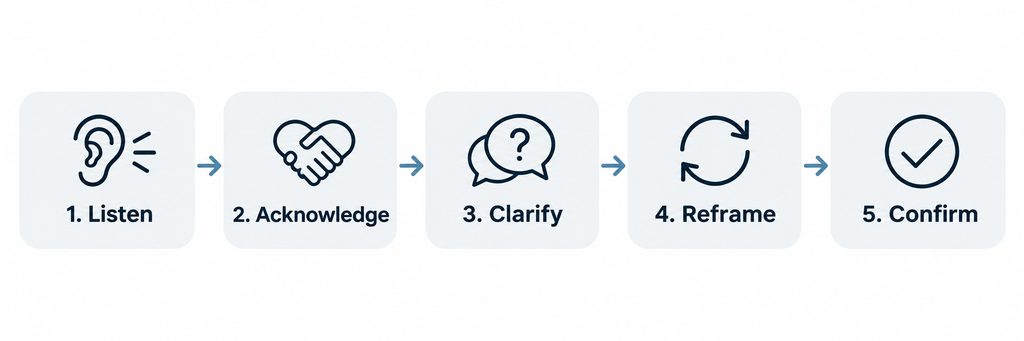
This approach combines listening, emotional acknowledgement, structured questioning and constructive reframing.
For Malaysian businesses handling enquiries through WhatsApp, live chat, email and telephone, communication exercises should also reflect the channels and languages employees use.
For instance, an employee responding through WhatsApp must communicate empathy through concise written messages, while telephone support requires greater attention to tone, interruptions and speaking pace.
Training should therefore reflect actual customer interactions rather than rely entirely on generic communication exercises.
When Is NLP Customer Service Training Worth Considering?
NLP training may be worth exploring when employees understand their responsibilities but struggle with difficult conversations, listening or emotional self-management.
However, communication training cannot resolve every customer service problem.
| Business Problem | Recommended Priority |
| Employees become defensive | Emotional control training |
| Customers feel misunderstood | Active listening exercises |
| Employees struggle with complaints | Reframing and de-escalation |
| Refunds are consistently delayed | Improve internal processes |
| Product information is inaccurate | Product knowledge training |
Businesses should identify the underlying cause of poor service before investing in training.
Research supporting NLP as a complete methodology remains limited. A systematic review published online in 2018 and included in the 2019 volume of Human Resource Development Quarterly examined seven eligible organisational studies. It identified possible psychological benefits but raised concerns about research quality and exaggerated claims.
Therefore, employers should evaluate practical communication improvements rather than assume that NLP certification guarantees better service.
When comparing training providers, businesses should prioritise relevant course content, realistic role-playing, trainer experience and opportunities for follow-up coaching.
How Can Businesses Measure Improvements After NLP Training?
Businesses can evaluate customer service communication training by comparing employee performance and customer outcomes before and after training.
Useful indicators include:
- Customer Satisfaction (CSAT): Customer ratings following service interactions.
- First Contact Resolution (FCR): Issues resolved without repeat contact.
- Complaint Escalation Rate: Complaints transferred to supervisors.
- Quality Assurance Scores: Employee performance against communication standards.
- Repeat Complaints: Customers returning with unresolved issues.
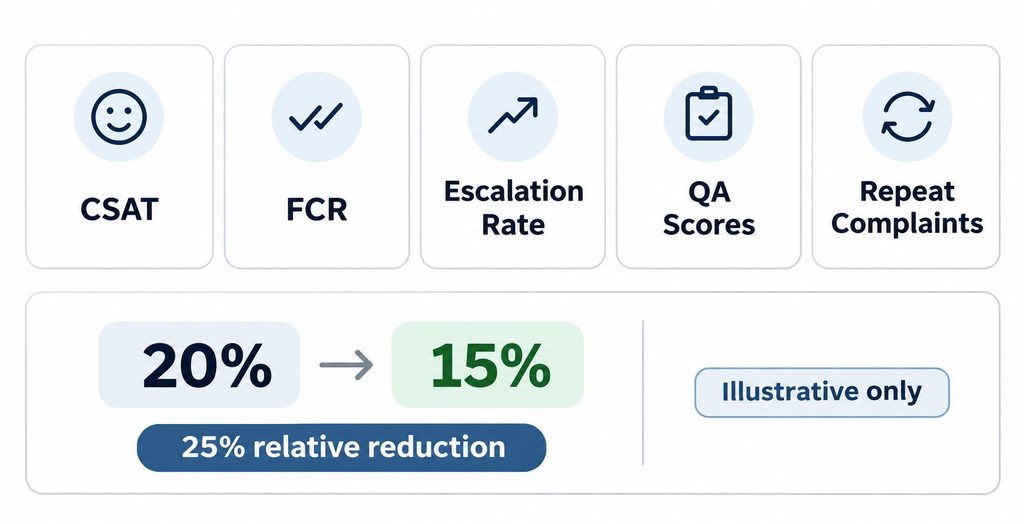
For example, suppose a company’s complaint escalation rate falls from 20% to 15% after training.
That represents a 5-percentage-point decrease, or a 25% relative reduction.
These are hypothetical figures. Actual improvements may also result from changes in staffing, service procedures or complaint volumes.
Businesses should combine performance metrics with conversation reviews and supervisor feedback to assess whether communication has genuinely improved.
Boosting Your Customer Service Performance
NLP-inspired customer service training includes exercises focused on listening, emotional self-management, rapport and difficult conversations. These are useful areas for employee development, although evidence supporting NLP as a complete methodology remains limited.
Malaysian businesses looking to strengthen their customer-facing teams can explore The Box Training and our NLP training programmes as part of their employee development plans. Identifying recurring communication challenges and specific service improvement goals beforehand can help determine which training approach best suits the organisation.
Sources
- Kotera, Y., Sheffield, D., & Van Gordon, W. (2019): The Applications of Neuro-Linguistic Programming in Organizational Settings: A Systematic Review of Psychological Outcomes, Human Resource Development Quarterly
- Herhausen, D., et al. (2023): Complaint De-Escalation Strategies on Social Media, Journal of Marketing
- Sturt, J., et al. (2012): Neurolinguistic Programming: A Systematic Review of the Effects on Health Outcomes, British Journal of General Practice
Frequently Asked Questions
What Does NLP Mean in Customer Service?
NLP stands for Neuro-Linguistic Programming. In customer service, it refers to applying ideas from NLP to communication exercises, including listening, rapport-building and emotional awareness. These skills are not unique to NLP.
Can NLP Help Employees Handle Angry Customers?
Communication exercises involving emotional awareness, empathy and active listening may help employees respond more constructively to angry customers. However, research has not firmly established that NLP-based training is more effective than other communication training approaches.
Successful complaint handling also depends on clear procedures and effective problem resolution.
Is NLP Customer Service Training Suitable for Beginners?
Yes. Beginners can practise fundamental techniques such as active listening, clarifying questions, emotional awareness and reframing without completing advanced NLP certification.
How Long Does It Take to Improve Customer Service Communication?
There is no fixed timeframe. Progress depends on training quality, employee participation and regular practice. Businesses can monitor improvements through customer feedback, coaching and performance reviews.
Is NLP the Same as Customer Service Communication Training?
No. NLP is a broader communication and behavioural development framework. Customer service communication training focuses specifically on skills such as complaint handling, customer interactions and service recovery.
Does NLP Training Guarantee Better Customer Satisfaction?
No. NLP training does not guarantee higher satisfaction. Results depend on employee development, service procedures and operational performance. Businesses should measure improvements using relevant customer service indicators.