
Key Takeaways
- Communication techniques often taught in NLP training, such as clearer questioning and emotional self-management, may help professionals handle difficult negotiations.
- Perceptual positions encourage negotiators to consider their own perspective, the other party’s viewpoint and a neutral position.
- Reframing objections helps explore concerns about price, risk, delivery or value without dismissing the other person’s position.
- Emotional state management may reduce rushed concessions, defensive responses and unnecessary conflict.
- Effective negotiation communication skills require preparation, active listening, clear boundaries and regular practice.
Introduction
NLP negotiation techniques offer structured ways to communicate under pressure through perspective-taking, thoughtful language, objection reframing and emotional self-management.
While scientific evidence supporting Neuro-Linguistic Programming (NLP) as a complete system remains limited, some of its associated practices have stronger foundations in communication and negotiation research.
For Malaysian sales professionals, managers and customer-facing employees, pressure often arises when clients demand discounts, suppliers change their terms or internal teams disagree over priorities.
The challenge is responding confidently without damaging relationships or compromising business objectives.
This guide explores practical NLP-inspired techniques that employees can apply during workplace negotiations.
NLP Negotiation Techniques at a Glance
| Technique | Purpose | Workplace Application |
| Perceptual positions | Consider different viewpoints | Resolving client disagreements |
| Language patterns | Encourage clearer communication | Clarifying unclear demands |
| Reframing objections | Explore underlying concerns | Handling price objections |
| Emotional state management | Reduce reactive responses | Managing tense negotiations |
| Rapport building | Establish mutual understanding | Maintaining client relationships |
What Is NLP for Negotiation?
Neuro-Linguistic Programming (NLP) is an approach to communication and behaviour that focuses on relationships between language, thinking patterns and responses.
In negotiation, exercises associated with NLP can help professionals practise recognising assumptions, exploring alternative viewpoints and responding more deliberately. However, these practices are not unique to NLP.
For example, when a customer says a product is too expensive, an immediate response might involve defending the price.
A more productive question would be:
“Which part of the proposal concerns you most?”
This encourages the customer to explain whether the issue involves budget limitations, perceived value or unnecessary features.
Effective negotiation begins with understanding the objection before attempting to resolve it.
However, NLP should not be treated as a scientifically established system for influencing others. Research supporting its overall effectiveness remains limited, while individual practices such as active listening and perspective-taking have stronger foundations in negotiation research.
How Can Perceptual Positions Improve Negotiation Communication?
Perceptual positions encourage negotiators to examine situations from three perspectives: their own, the other person’s and a neutral observer’s.
Considering different viewpoints may be useful when disagreements become tense. Research supports perspective-taking in negotiation, although it does not specifically validate the NLP three-position exercise.
First Position: Understand Your Own Perspective
The first position focuses on your objectives, concerns and boundaries.
Before negotiating, consider:
- What outcome am I trying to achieve?
- Which terms can I negotiate?
- What would make an agreement unacceptable?
For example, a Malaysian account manager negotiating a contract renewal might need to maintain profitability while preserving a longstanding customer relationship.
Recognising both priorities helps prevent unnecessary concessions.
Second Position: Consider the Other Person’s Perspective
The second position involves examining the situation from the other party’s viewpoint.
A procurement manager requesting a discount might be working within a strict departmental budget rather than questioning the supplier’s value.
Understanding this possibility allows the salesperson to explore alternative payment arrangements, contract durations or service packages.
Research published in Psychological Science found that perspective-taking can improve negotiation outcomes, particularly when identifying mutually beneficial trade-offs. The findings are discussed in the study Why It Pays to Get Inside the Head of Your Opponent.
Third Position: Observe the Conversation Objectively
The third position involves mentally stepping outside the discussion.
Imagine observing the negotiation as an impartial colleague.
Ask yourself:
- Is either person becoming defensive?
- Are both parties discussing the actual problem?
- What could move the conversation forward?
For example, two department heads arguing over resources might discover that their underlying concern is meeting deadlines.
Recognising this shifts the discussion towards workload distribution.
Which NLP Language Patterns Are Useful During Negotiations?
Effective negotiation language makes concerns more specific, reduces confrontation and encourages useful information-sharing.
Several questioning techniques associated with NLP can support these objectives.
Clarify Vague Statements
Negotiations often become difficult when participants make broad statements without explaining them.
For example:
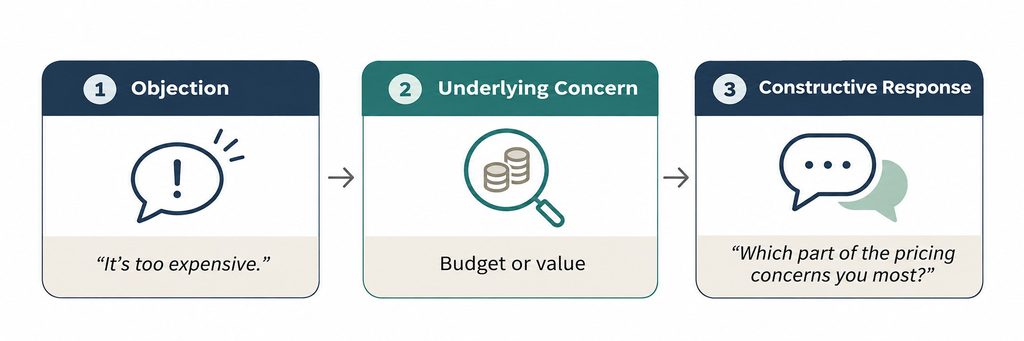
“Your service is too expensive.”
Instead of immediately offering a discount, ask:
“Which part of the pricing is causing the greatest concern?”
Other useful questions include:
- “What would make this proposal more suitable?”
- “Which requirement are we currently unable to meet?”
- “What information would help you make a decision?”
These questions encourage the other person to explain the concern behind a general objection, giving both parties a clearer starting point for discussion.
Challenge Assumptions Without Creating Conflict
A customer might say:
“Your team will never complete this project on time.”
Responding defensively creates an argument about credibility.
A more productive response is:
“Which part of the proposed timeline concerns you most?”
This encourages the customer to identify specific risks, allowing the business to respond with relevant information.
Summarise Before Responding
Summarising demonstrates that you understand the other person’s position.
For example:
“So your priorities are maintaining the current budget and ensuring delivery before December. Have I understood that correctly?”
This gives the other party an opportunity to confirm or correct your understanding.
It also helps employees avoid responding to assumptions rather than actual requirements.
How Can You Reframe Objections During Negotiations?
Reframing involves examining a problem from another perspective to identify possible solutions.
It does not mean dismissing concerns or manipulating someone into agreement.
An effective reframe acknowledges the objection while redirecting attention towards the underlying business requirement.
Example 1: Handling Price Objections
Customer: “Your proposal costs too much.”
Reframed response: “I understand the budget matters. Would it help to review which services deliver the most value to your team?”
This creates an opportunity to discuss priorities rather than immediately reducing the price.
Example 2: Handling Delivery Concerns
Customer: “Your implementation timeline is too long.”
Reframed response: “It sounds like getting started quickly is your priority. Which functions must be ready first?”
The discussion shifts towards identifying whether phased implementation is possible.
Example 3: Managing Internal Disagreements
Manager: “We don’t have enough people to complete this project.”
Reframed response: “Which activities require additional capacity, and which could be rescheduled?”
Instead of arguing about staffing levels, both parties can examine workload priorities.
Common Objections and Better Responses
| Objection | Concern to Investigate | Suggested Response |
| “It’s too expensive.” | Budget or perceived value | “Which cost concerns you most?” |
| “We need more time.” | Risk or approval | “What information would help?” |
| “Your competitor is better.” | Features or performance | “Which differences matter most?” |
| “This won’t work.” | Feasibility | “Which requirement isn’t being met?” |
Successful reframing changes the direction of the conversation without changing the facts.
How Can You Manage Emotions During High-Pressure Negotiations?
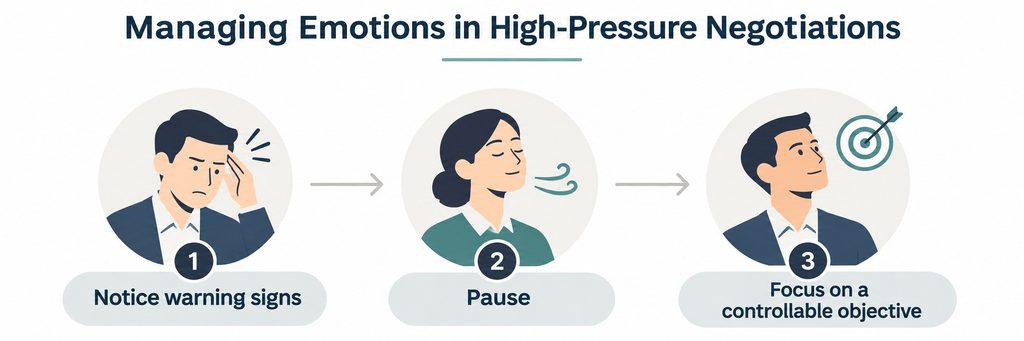
Emotional state management involves recognising when frustration, anxiety or defensiveness begins influencing your communication.
The objective is to reduce the risk of emotional reactions affecting important business decisions.
Recognise Your Warning Signs
Common signs that pressure is affecting your communication include:
- Interrupting before someone finishes speaking
- Feeling an immediate need to defend yourself
- Agreeing to concessions to end an uncomfortable discussion
- Repeating arguments without considering new information
Recognising these behaviours creates an opportunity to pause.
Pause Before Responding
When a negotiation becomes tense, take a moment before answering.
You might say:
“Let me consider that point before I respond.”
Or:
“I want to make sure I understand your concern correctly.”
A short pause gives you time to decide whether to clarify, acknowledge or propose an alternative.
Focus on a Controllable Objective
An employee might enter a negotiation thinking:
“I must close this deal today.”
This expectation can create unnecessary pressure.
A more practical objective is:
“I need to understand the customer’s priorities and determine whether we can reach an acceptable agreement.”
The revised objective encourages sound judgement rather than rushed decisions.
Research discussed by Harvard Business School on emotions in business negotiation highlights the importance of emotional awareness, listening and responding thoughtfully during difficult discussions.
How Do NLP Negotiation Techniques Work in a Sales Situation?
Consider a hypothetical Malaysian software company negotiating an annual service agreement.
The original quotation is RM60,000.
The customer requests a 20% discount because another supplier offers a cheaper package.
A 20% reduction would lower the contract value by RM12,000, resulting in a revised price of RM48,000.
Step 1: Understand Both Perspectives
The salesperson needs to protect profitability, while the customer wants to control spending.
Recognising both priorities prevents the conversation from becoming unnecessarily confrontational.
Step 2: Clarify the Objection
The salesperson asks:
“Is your main concern the annual budget, or are there services you don’t expect to use?”
The customer explains that several optional features are unnecessary.
Step 3: Reframe the Discussion
Instead of reducing the price of the complete package, the salesperson suggests reviewing the service scope.
Both parties can now discuss a package that better matches the customer’s requirements.
Step 4: Confirm the Next Action
The customer identifies essential features, while the salesperson prepares a revised quotation for approval.
The negotiation moves from an unsupported discount request towards a more informed commercial decision.
This scenario is illustrative. Actual outcomes depend on pricing structures, operating costs and customer requirements.
When Should Employees Avoid Relying on NLP Alone?
NLP negotiation techniques can support communication practice, but they cannot replace commercial knowledge, preparation or professional judgement.
For example, reframing cannot resolve a genuine contractual breach, while emotional control cannot make an unprofitable agreement financially sustainable.
Before negotiating, employees should understand:
- Their organisation’s minimum acceptable terms
- Which concessions require management approval
- The customer’s actual requirements
- Available alternatives if negotiations fail
- Relevant contractual and operational risks
For complex legal disputes, major procurement decisions or contractual disagreements, specialist advice and appropriate management involvement remain necessary.
Read More: Fixing Imposter Syndrome: NLP for Malaysian Mid-Level Executives
How Can Malaysian Businesses Improve Negotiation Skills Through Training?
Effective negotiation training combines communication techniques with realistic workplace scenarios and constructive feedback.
Businesses can begin by identifying the situations employees find most challenging.
These might include pricing objections, customer complaints, supplier negotiations or disagreements between departments.
Practical 20-Minute Negotiation Exercise
A short role-play exercise can help employees practise their responses.
Minutes 1–5: Define the Scenario
Choose a realistic situation, such as a customer requesting an unauthorised discount.
Minutes 6–10: Conduct the Negotiation
One employee plays the customer while another practises questioning, reframing and emotional control.
Minutes 11–15: Review the Conversation
An observer provides feedback on listening, clarity, professionalism and commercial boundaries.
Minutes 16–20: Repeat With Improvements
Participants repeat the discussion using the feedback.
Managers can review role-play feedback, employees’ questioning and listening skills, and whether agreed commercial boundaries are followed.
Tracking these measures over time can help identify improvements and areas needing further practice.
The exercise is a practical training suggestion rather than a scientifically validated NLP protocol.
Improving Your Company’s Negotiations
Perspective-taking, structured questioning, objection reframing and emotional awareness are practical communication skills for approaching difficult conversations.
Although these skills are often included in NLP training (and commonly mentioned by NLP master practitioners), their value should be assessed independently of broader NLP claims.
For Malaysian businesses, practising these skills can encourage more thoughtful communication while maintaining professional relationships and commercial boundaries.
If your organisation wants to strengthen workplace negotiation and communication skills, The Box Training offers NLP training programmes focused on practical communication, leadership and professional development. Consider identifying your team’s most challenging negotiation scenarios before selecting a programme that addresses those specific needs.
Frequently Asked Questions About NLP for Improving Negotiation Techniques
What Are the Most Useful NLP Negotiation Techniques?
Perceptual positions, reframing, clarification questions and emotional state management are commonly taught techniques for approaching difficult negotiations. Their effectiveness depends on the situation, and evidence supporting individual communication skills is stronger than evidence for NLP as a complete system.
Can NLP Help Salespeople Handle Difficult Customers?
NLP-inspired communication exercises may help salespeople practise calmer responses and clearer questioning. Successful negotiations also require product knowledge, realistic offers and good commercial judgement.
How Can I Stay Calm During a Tense Negotiation?
Pause before responding, clarify the disagreement and focus on your objective. If emotions begin affecting your judgement, request a short break before making important commitments.
Is NLP Useful for Salary Negotiations?
NLP-inspired questioning and perspective-taking can provide a useful structure for salary discussions. Employees should also prepare salary benchmarks, evidence of their contributions and realistic alternatives before negotiating.
What Is the Difference Between Reframing and Manipulation?
Reframing presents a concern from another useful perspective without changing the facts. Manipulation involves misleading someone, concealing important information or applying inappropriate pressure.
How Long Does It Take to Improve Negotiation Communication Skills?
There is no fixed learning period. Employees can begin practising immediately, but sustained improvement requires repeated exercises, feedback and experience in real negotiations.