Key Takeaways
- NLP communication techniques include clearer language, active listening, rapport-building and understanding different perspectives.
- Asking specific questions helps employees clarify expectations and reduce misunderstandings.
- Active listening involves understanding and verifying a colleague’s message before responding.
- Constructive feedback should address observable behaviour, its impact and practical next steps.
- NLP offers structured communication exercises, although scientific evidence supporting NLP as a complete system remains limited.
NLP for workplace communication introduces techniques associated with Neuro-Linguistic Programming, including questioning, active listening, reframing and rapport-building. These exercises may help employees develop clearer communication habits, although NLP itself has limited scientific support.
In Malaysian workplaces, misunderstandings can arise from unclear instructions, different expectations or hesitation to question colleagues and managers.
Practising clearer questioning, active listening and constructive feedback may help employees address these challenges. These skills can also be useful independently of NLP practitioner training.
This guide covers seven practical techniques teams can apply during meetings, project discussions and everyday workplace interactions.
What Is NLP in Workplace Communication?
Neuro-Linguistic Programming (NLP) is an approach to communication and personal development that explores proposed relationships between language, thought patterns and behaviour.
In workplace settings, NLP training commonly introduces techniques such as active listening, questioning, reframing and rapport-building.
The objective is to help employees become more aware of how their words, assumptions and responses influence conversations.
However, NLP should not be treated as a scientifically proven solution to communication problems.
A 2012 systematic review published in the British Journal of General Practice examined 10 experimental studies and found little evidence that NLP improves health-related outcomes. The researchers also highlighted limitations in the quality and quantity of available research.
A 2019 review of NLP research and coaching found that practices distinctive to NLP were poorly supported by scientific evidence.
Although these studies do not directly establish whether individual workplace exercises are effective, they highlight the importance of separating practical communication skills from broader claims about NLP.
Common NLP Communication Applications
| Workplace Challenge | Communication Technique | Practical Application |
| Unclear instructions | Precision questioning | Confirm deadlines and expectations |
| Poor listening | Active listening | Summarise before responding |
| Weak rapport | Communication adaptation | Adjust tone and explanation |
| Misunderstandings | Reframing | Separate facts from assumptions |
| Uncomfortable feedback | Constructive feedback | Discuss behaviour and solutions |
| Team disagreements | Perspective-taking | Understand different priorities |
1. How Can NLP Improve Communication Clarity?
NLP-inspired questioning encourages employees to replace vague statements with specific, actionable information.
Consider a manager saying:
“Please improve the report and send it over soon.”
The employee still needs to know what requires improvement and when the report is due.
Instead of making assumptions, they could ask:
- “Which sections need improvement?”
- “What changes would make the report acceptable?”
- “Would you like the revised version by 3 pm today?”
This approach is associated with the NLP Meta Model, which encourages questioning missing information and unclear generalisations.
Confirm Expectations Before Starting Work
When receiving an assignment, clarify:
- Deliverable: What needs to be completed?
- Standard: What does an acceptable result look like?
- Deadline: When is it required?
- Responsibility: Who will review or approve it?
For Malaysian employees coordinating through WhatsApp, email or Microsoft Teams, a short written confirmation may help reduce confusion when instructions change.
For example, an employee could follow up with:
“Just confirming that I’ll revise the presentation slides, update the sales figures and send the final version by Thursday afternoon.”
This gives the manager an opportunity to correct misunderstandings before work begins.
2. How Can NLP Help Employees Become Better Listeners?
Active listening involves understanding and verifying someone’s message before responding.
Employees sometimes focus on preparing their replies instead of understanding what their colleagues are saying.
A practical approach is the Listen, Reflect and Clarify method.
Practise the Three-Step Listening Method
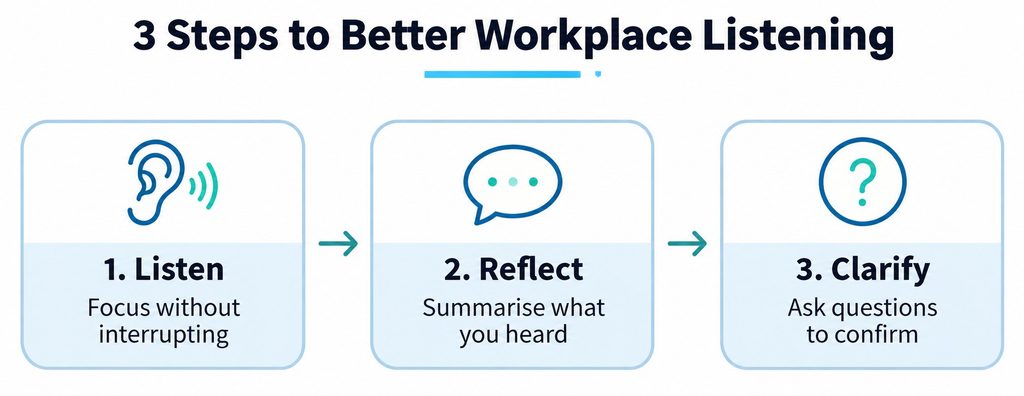
Step 1: Listen
Allow the speaker to explain their concern without interrupting.
Step 2: Reflect
Summarise what you understood.
For example:
“So receiving the figures late means you don’t have enough time to complete your analysis?”
Step 3: Clarify
Ask a question that moves the conversation forward.
“What time would you need the figures to avoid delaying your report?”
This creates an opportunity to resolve the issue instead of arguing about who is responsible.
Research also supports the broader value of listening. A meta-analysis published in the Journal of Business and Psychology found positive associations between perceived listening quality and workplace outcomes. However, this does not establish the effectiveness of NLP itself.
Common Listening Mistakes to Avoid
Even well-intentioned employees can undermine conversations by:
- Interrupting to offer solutions before understanding the problem.
- Assuming they know what a colleague means.
- Responding defensively to criticism.
- Checking messages while someone is speaking.
- Asking several questions without allowing time for answers.
A useful habit is to summarise the speaker’s concern before offering advice. This helps confirm whether both people understand the situation in the same way.
3. How Can NLP Help Build Rapport Between Colleagues?
Rapport can improve when employees communicate respectfully, recognise different preferences and demonstrate genuine interest in others.
NLP training may introduce pacing and mirroring as rapport-building techniques. However, deliberately copying someone’s gestures or posture is unnecessary for effective communication, and evidence for NLP-specific benefits remains limited.
A more practical approach is to adapt how information is presented.
Adjust Your Communication Style
Imagine two colleagues discussing a project.
One prefers short updates focusing on deadlines.
The other wants supporting information before making decisions.
For the first colleague:
“The proposal is ready. Two sections need approval before Friday.”
For the second:
“The proposal is ready. I’ve highlighted two sections requiring approval and included the supporting figures.”
Both receive the same essential information in a format that suits their working preferences.
Building Rapport in Malaysian Workplaces
Malaysian teams often include colleagues with different professional backgrounds, communication preferences and levels of seniority.
Some employees prefer discussing concerns privately, while others are comfortable raising questions during meetings.
Instead of assuming how someone wants to communicate, ask about their preferences.
For example:
“Would you prefer a quick discussion, or should I send the details for you to review first?”
Small adjustments like this may make collaboration more comfortable without forcing employees to change their personalities.
Read More: How NLP Helps Employees Stay and Grow
4. How Can NLP Reduce Workplace Misunderstandings?
Reframing encourages employees to consider alternative interpretations before reacting to a situation.
Imagine submitting a proposal to your manager and receiving no response for two days.
You might assume:
“My manager dislikes my proposal.”
However, the only confirmed information is that the manager has not responded.
A more constructive approach would be:
“Hi, just checking whether you’ve had a chance to review the proposal. Is there anything you’d like me to clarify?”
Replace Assumptions With Questions
| Initial Thought | Constructive Alternative |
| “They never cooperate.” | “Which requests haven’t received responses?” |
| “This project is impossible.” | “What’s the biggest obstacle?” |
| “My manager keeps criticising me.” | “What specific improvements are being requested?” |
| “The client is difficult.” | “Which expectations haven’t been aligned?” |
Reframing does not mean ignoring genuine problems.
If employees experience harassment, discrimination or unreasonable demands, those issues require appropriate management or HR intervention.
The objective is to distinguish situations that can be resolved through clarification from problems requiring organisational action.
5. How Can NLP Improve Workplace Feedback?
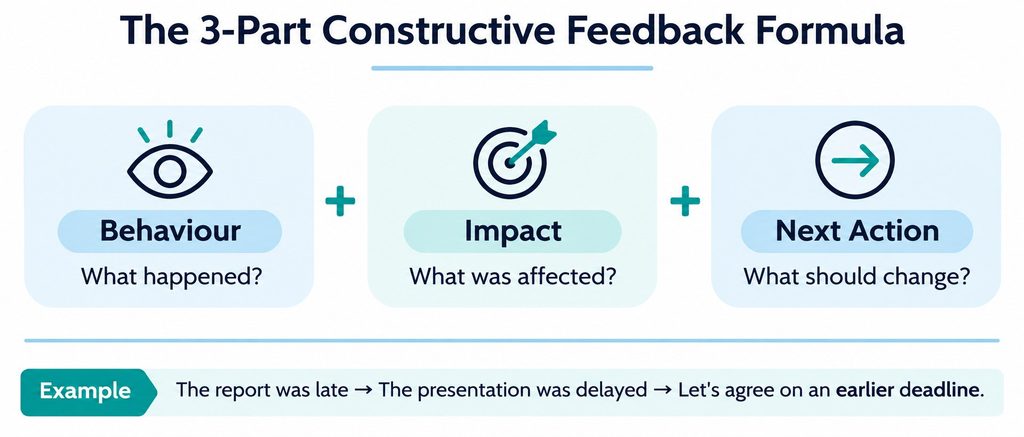
Constructive feedback focuses on specific behaviour, its impact and an achievable improvement.
Instead of telling an employee:
“You need to be more responsible.”
A manager could say:
“The last two reports were submitted after the deadline, which delayed our client presentation. What can we adjust to ensure the next report arrives on time?”
This approach provides information the employee can act on.
Use the Behaviour, Impact and Next Action Method
Behaviour: Explain what happened without making personal judgements.
Impact: Describe how the behaviour affected the task or team.
Next Action: Agree on a practical improvement.
This approach shares principles with established behaviour-focused feedback frameworks, such as the Center for Creative Leadership’s Situation–Behaviour–Impact model.
Employees receiving feedback can also ask:
- “Could you give me an example?”
- “Which area should I prioritise?”
- “What would a stronger result look like?”
Feedback becomes more useful when both parties understand the expectations.
Choose the Right Setting for Feedback
Not every conversation belongs in a group meeting.
Sensitive performance feedback is generally better handled privately, allowing employees to ask questions without feeling embarrassed.
Managers should also avoid overwhelming employees with too many improvement requests at once.
Focusing on one or two specific behaviours can make feedback easier to understand and act upon.
6. How Can NLP Improve Team Conversations?
Perspective-taking encourages employees to understand competing priorities and identify shared objectives.
Consider a sales department requesting an immediate campaign launch while the marketing department needs time to verify promotional materials.
Both departments want the campaign to succeed, but their immediate priorities differ.
Examine Three Perspectives
Your perspective: What do you need, and why?
Sales needs the campaign launched before a customer opportunity closes.
The other person’s perspective: What concerns influence their decision?
Marketing needs to ensure the materials are accurate and approved.
The shared objective: What outcome benefits both departments?
Both teams could agree to launch approved materials first while completing the remaining reviews.
This exercise encourages employees to approach disagreements as shared problems rather than personal conflicts. Its effectiveness depends on the situation and how the discussion is handled.
Why Team Communication Matters
Google’s Project Aristotle research on team effectiveness examined 180 teams and identified five important dynamics associated with effective teamwork:
- Psychological safety.
- Dependability.
- Structure and clarity.
- Meaning.
- Impact.
These findings show that clear expectations and psychological safety were associated with team effectiveness in Google’s research.
Although the research does not establish NLP’s effectiveness, it supports the broader importance of communication practices that encourage understanding and participation.
7. How Can Teams Practise NLP Communication Skills?
Short, structured exercises give employees opportunities to practise communication techniques using familiar workplace situations.
A simple 20-minute session can introduce several techniques without complicated activities. This is a suggested practice format rather than a scientifically validated NLP intervention.
20-Minute Team Communication Exercise
Minutes 0–5: Identify Communication Problems
Each participant describes one recurring challenge, such as unclear instructions or delayed feedback.
Minutes 5–10: Practise Active Listening
Work in pairs. One person describes a workplace problem while the other listens and summarises the concern.
Minutes 10–15: Practise Reframing
Rewrite vague or negative statements into constructive questions.
For example:
“The other department never helps us.”
Becomes:
“Which requests haven’t been addressed, and how can we improve coordination?”
Minutes 15–20: Agree on Improvements
Each participant selects one communication technique to practise during the following week.
How Can Teams Measure Improvement?
Teams can track practical indicators such as:
- Number of tasks requiring clarification.
- Frequency of misunderstandings during project handovers.
- Employee feedback on meeting clarity.
- Number of unresolved action items after meetings.
For example, if 12 out of 40 requests require clarification, the clarification rate is 30%.
If that falls to 6 out of 40 comparable requests, the rate becomes 15%.
This is a hypothetical example, not a documented NLP training result. Actual improvements depend on the workplace, task complexity and consistency of implementation.
Teams should compare similar tasks over multiple weeks before drawing conclusions about whether their communication practices have improved.
Is NLP Training Suitable for Every Workplace?
NLP-based training may provide structured opportunities for employees to practise listening, questioning, feedback and interpersonal communication.
It may be relevant for:
- Managers: Communicating expectations and providing feedback.
- Customer service teams: Understanding concerns and responding professionally.
- Sales employees: Building rapport and clarifying customer requirements.
- Project teams: Coordinating responsibilities and resolving misunderstandings.
- New employees: Practising questions and developing communication confidence.
However, employers should evaluate training based on practical exercises, trainer experience and measurable learning objectives rather than assume that NLP itself guarantees better results.
Communication training also cannot resolve organisational problems such as unclear reporting structures, unreasonable workloads or poor management practices.
Before enrolling employees, identify the situations they struggle with most. A team experiencing frequent project handover problems may benefit more from clarity and questioning exercises than general confidence-building activities.
Using NLP to Improve Your Workplace Communications
NLP-based communication training introduces exercises that encourage employees to reflect on how they listen, ask questions, interpret messages and respond to colleagues.
By practising clearer questioning, active listening, reframing and constructive feedback, teams may develop more effective communication habits. However, these potential benefits should be distinguished from broader claims about NLP’s scientific effectiveness.
For Malaysian organisations seeking structured communication development, The Box Training offers NLP training that teams can consider as part of their learning and development plans. Identify your team’s communication challenges first, then choose training activities that address those situations through practical exercises.
Frequently Asked Questions About Whether NLP Can Improve Workplace Communication
Is NLP Effective For Workplace Communication?
NLP introduces communication exercises such as questioning, reframing and rapport-building. However, scientific evidence supporting NLP as a complete system remains limited. Individual communication practices may still be useful independently of NLP.
Can NLP Help Employees Communicate With Difficult Colleagues?
Certain communication practices also taught in NLP courses, such as active listening and clarification questions, may help employees discuss misunderstandings constructively. However, persistent conflict or inappropriate behaviour may require management or HR support.
What Is the Easiest NLP Technique To Practise At Work?
Start with clarification questions. Ask colleagues to specify deadlines, expectations and desired outcomes whenever instructions are unclear.
Can NLP Improve Communication Between Managers And Employees?
Structured communication practice may help managers explain expectations and provide feedback while giving employees opportunities to ask questions. These benefits should not be attributed specifically to NLP without stronger evidence.
Is NLP Suitable For Introverted Employees?
NLP communication exercises do not require employees to be extroverted. Thoughtful questioning, active listening and written clarification can suit different communication preferences.
How Long Does It Take To Improve NLP Communication Skills?
There is no established timeline for mastering NLP communication skills. Employees can practise individual techniques immediately, but developing consistent habits requires repetition, feedback and real workplace application.