Key Takeaways
- NLP includes communication techniques that may help sales professionals understand objections, build rapport and respond more thoughtfully, although evidence for NLP as a complete system remains limited.
- Customer objections often involve concerns about pricing, value, trust, timing or perceived risk.
- Active listening, reframing and targeted questioning can help salespeople explore what customers actually need.
- Training to handle difficult customers is most useful when it includes realistic scenarios, practice and constructive feedback.
- NLP is not a guaranteed sales solution. Businesses should evaluate improvements in communication and customer outcomes.
Handling customer sales objections becomes easier when sales professionals understand the concerns behind a customer’s hesitation. Communication skills such as active listening, questioning and reframing may help salespeople address objections more effectively without pressuring customers into decisions.
These techniques are also used in Neuro-Linguistic Programming (NLP) training, although evidence for NLP as a complete system remains limited.
For Malaysian businesses, these skills are particularly relevant when customers question prices, compare competitors or challenge whether a product is worth purchasing.
However, overcoming objections does not mean winning every argument. Sometimes, the best sales conversation ends with a clearer understanding of the customer’s needs, even if they are not ready to buy.
What Is NLP in Sales Objection Handling?
Neuro-Linguistic Programming (NLP) is an approach to communication and behavioural change that focuses on how people use language, interpret experiences and respond to situations.
In sales, NLP-inspired exercises focus on recognising customer concerns, asking clearer questions and adjusting communication styles. These skills can also be developed through broader, evidence-informed sales training.
For example, consider a customer who says:
“I think your service is too expensive.”
An inexperienced salesperson might immediately offer a discount.
A more thoughtful response would be:
“I understand. Are you comparing our price with another provider, or are you unsure whether the service offers enough value?”
This question helps identify the actual concern before proposing a solution.
How NLP Relates to Common Sales Objections
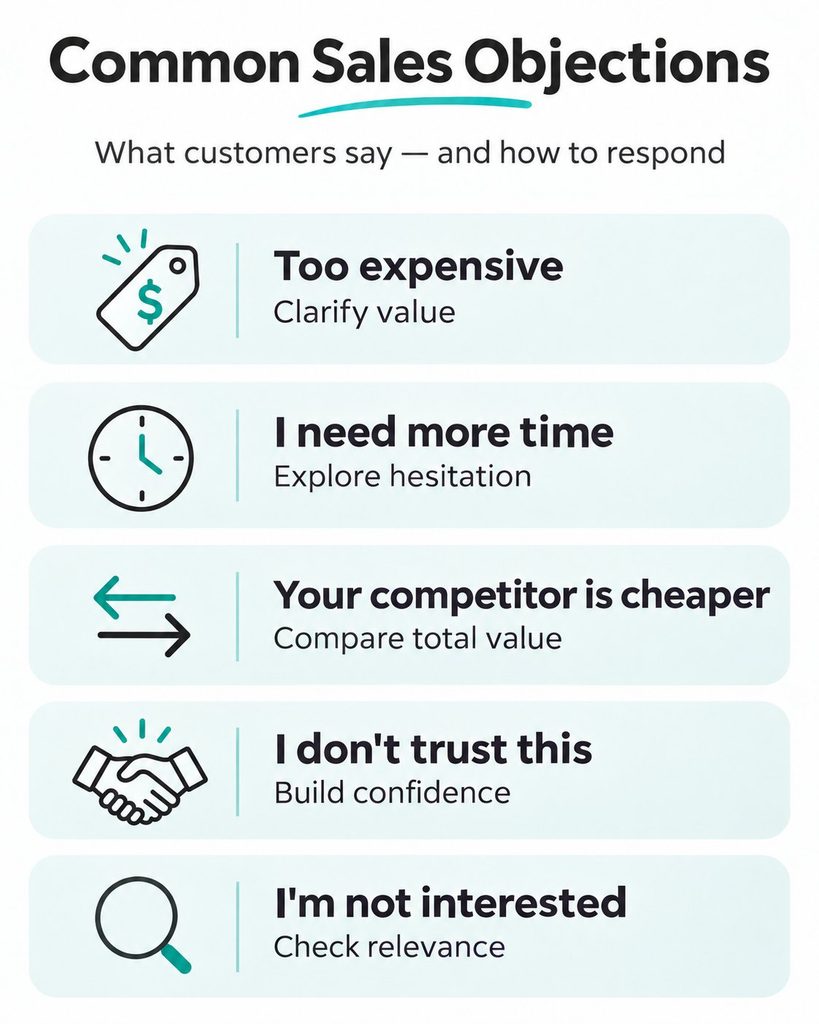
The goal of NLP-inspired objection handling is to create clearer conversations that support informed purchasing decisions.
Why Do Customers Raise Sales Objections?
Customers raise objections when something about a purchase remains unresolved. The concern might be financial, practical, emotional or related to insufficient information.
Understanding the underlying reason helps salespeople avoid unnecessary arguments.
Price and Budget Concerns
A customer considering a RM5,000 business software subscription might compare it with a cheaper RM3,000 alternative.
However, the price difference may not be their only concern. They might also question whether the software will solve their problems, whether employees can use it effectively or whether additional costs exist.
Focusing exclusively on discounts may overlook these issues.
Lack of Trust
Customers may hesitate when they are unfamiliar with a company, particularly when purchasing expensive products or services.
In these situations, genuine testimonials, demonstrations and transparent service terms can help customers make better-informed decisions without relying on exaggerated promises.
Fear of Making the Wrong Decision
A purchasing manager might hesitate to replace an existing supplier because disruptions could affect operations.
The salesperson should explore these risks rather than dismiss them.
Poor Timing
Not every objection reflects dissatisfaction.
A customer might genuinely lack the budget, purchasing authority or immediate need to proceed.
Recognising these situations allows sales teams to recommend suitable next steps without unnecessary pressure.
How Can NLP Help Salespeople Deal With Difficult Customers?
Skills commonly taught in a NLP program, such as listening, reframing and clarifying questions, can provide a practical structure for challenging sales discussions.
However, their usefulness should not be taken as proof that NLP itself improves sales performance.
A 2012 systematic review published in the British Journal of General Practice found insufficient high-quality evidence supporting NLP for health-related outcomes.
The review examined health-related outcomes, not sales performance, so its findings cannot establish whether NLP improves sales results. Businesses should assess communication training through measurable workplace outcomes rather than assuming NLP-specific benefits.
Build Rapport Before Addressing Objections
Rapport involves establishing a comfortable, respectful connection with another person.
Customer: “I’ve spoken to three suppliers already, and none can meet our requirements.”
Salesperson: “That sounds frustrating. Which requirement has been the hardest for suppliers to meet?”
Instead of immediately promoting a solution, the salesperson acknowledges the customer’s frustration and invites clarification.
Rapport-building involves:
- Listening without interrupting.
- Acknowledging legitimate concerns.
- Maintaining a calm, respectful tone.
- Avoiding exaggerated promises.
Research on salesperson listening also supports the importance of understanding customer concerns and adapting communication to their needs.
Use Reframing to Explore Different Perspectives
Reframing involves presenting an issue from another relevant perspective.
Customer: “Your equipment is more expensive than the other supplier’s.”
Salesperson: “That’s fair. Would it help if we compared maintenance requirements, warranty coverage and operating costs alongside the purchase price?”
This shifts the discussion from initial price to overall value.
However, reframing must be supported by accurate information. If a competitor genuinely offers better value, the salesperson should acknowledge that possibility.
Ask Specific Questions Using the NLP Meta Model
The NLP Meta Model is a questioning framework intended to clarify vague statements, assumptions and generalisations.
Consider a customer who says:
“Your service is unreliable.”
Instead of becoming defensive, the salesperson could ask:
“Could you tell me which part of the service has been unreliable?”
If the customer identifies inconsistent delivery updates, the discussion can focus on resolving that specific problem.
Clarifying questions can turn vague complaints into specific concerns that both parties can address.
Practise Emotional Self-Regulation
A defensive salesperson can unintentionally escalate an already difficult conversation.
Some NLP programmes include emotional regulation exercises, although evidence supporting NLP-specific techniques remains limited.
A practical approach is to develop a consistent response routine:
- Pause briefly before responding.
- Maintain a calm speaking pace.
- Focus on understanding the complaint.
- Ask one clarifying question.
- Agree on a practical next step.
The goal is to remain composed enough to make sensible decisions.
How Should Salespeople Respond to Common Customer Objections?
Effective objection handling combines acknowledgement, clarification and a relevant response.
Here are four realistic examples.
“Your Product Is Too Expensive”
Customer: “RM2,500 is too expensive. Another supplier quoted RM1,800.”
Salesperson: “I understand why you’d compare prices. Could we review what’s included in both quotations, particularly installation, warranty and support?”
Why this response may help: The salesperson encourages a fair comparison without dismissing the customer’s budget concerns.
“I Need to Think About It”
Customer: “Let me think about it first.”
Salesperson: “Of course. Is there anything specific you’re still uncertain about that I can help clarify?”
Why this response may help: The response respects the customer’s decision while allowing unresolved concerns to surface.
“I’ve Had a Bad Experience Before”
Customer: “The last provider promised everything but delivered nothing.”
Salesperson: “I understand why you’d be cautious. What went wrong previously, and what would you need to see from us to feel comfortable proceeding?”
Why this response may help: The salesperson acknowledges the customer’s experience and identifies what evidence could rebuild confidence.
“Your Company Made a Mistake”
Customer: “Your team promised delivery last Friday, and nothing arrived!”
Salesperson: “I’m sorry the delivery did not arrive as promised. Let me verify the status and confirm what we can do to resolve this.”
Why this response may help: The response prioritises accountability over persuasion.
When a customer has a legitimate complaint, resolving the problem matters more than winning the argument.
How to Handle Customer Sales Objections in 5 Steps
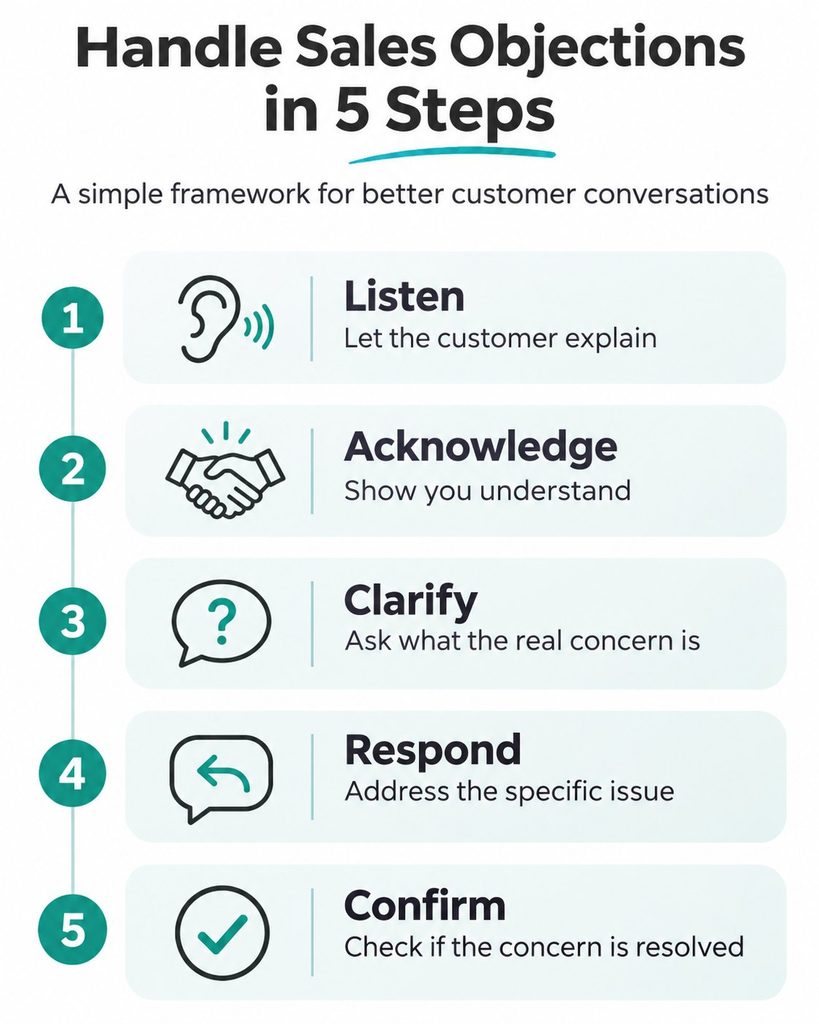
A structured approach helps salespeople respond consistently without memorising lengthy scripts.
The following five-step framework combines practical communication principles with techniques also used in NLP training. It is a suggested workplace approach, not a scientifically validated NLP-specific method.
Read More: Is Your Corporate Training PDPA Compliant in Malaysia?
Step 1: Listen
Allow customers to explain their concerns without interruption.
Avoid preparing your rebuttal while they are still speaking.
Step 2: Acknowledge
Recognise the customer’s concern without immediately becoming defensive.
For example: “I understand why that would be concerning.”
Step 3: Clarify
Ask questions to identify the actual purchasing barrier.
For example: “Is your main concern the price, or whether the product meets your requirements?”
Step 4: Respond
Provide relevant evidence, alternatives or a practical resolution.
Keep the explanation focused on the customer’s specific concern.
Step 5: Confirm
Check whether the concern has been addressed.
For example: “Does that clarify the warranty coverage, or is there anything else you’d like to review?”
This process encourages understanding before persuasion and gives salespeople a practical structure for handling difficult conversations.
When Should Sales Teams Consider NLP Training?
NLP training may be worth exploring when sales professionals struggle with customer communication, emotional conversations or identifying the concerns behind objections.
Potential situations include:
- Salespeople frequently interrupt customers or respond defensively.
- Teams rely on repetitive scripts that fail to address individual concerns.
- Employees struggle to explain value beyond pricing.
- Customer-facing staff lack confidence during disagreements.
- Sales managers want to improve questioning and listening skills.
However, training cannot resolve every business problem.
| Business Problem | Recommended First Action |
| Frequent product complaints | Review product quality |
| Recurring delivery disputes | Improve logistics processes |
| Uncompetitive pricing | Review pricing strategy |
| Incorrect sales promises | Improve product knowledge |
| Poor objection-handling skills | Consider communication training |
For example, a company experiencing repeated late deliveries will not solve the underlying problem by teaching employees to reframe customer complaints.
Communication training is most useful when sales teams have identifiable gaps in listening, questioning or customer interactions. Employers should select programmes based on demonstrated training needs rather than assuming NLP training is the best option.
How Can Employers Measure Whether Sales Training Works?
Employers should assess whether training improves workplace behaviour and customer outcomes, rather than relying solely on participant satisfaction.
In Malaysia, HRD Corp’s Training Effectiveness Evaluation (HRD-TEE) framework includes an Output Assessment that captures feedback at the end of training and an Outcome Assessment that evaluates understanding and application after a specified period.
Employers can adopt a similar approach when evaluating sales communication training.
Example: Measuring Sales Conversion Rates
Consider a hypothetical Malaysian B2B sales team handling 100 qualified enquiries monthly.
Before training, the team converts 20 enquiries into sales.
Conversion rate: 20 ÷ 100 × 100 = 20%
After training, suppose the team converts 25 out of 100 comparable enquiries.
New conversion rate: 25 ÷ 100 × 100 = 25%
This represents an increase of 5 percentage points, equivalent to a 25% relative improvement.
However, these figures are illustrative, not actual NLP training results.
Higher conversion rates do not automatically prove that training caused the improvement. Lead quality, pricing, promotions and market conditions may also influence sales.
Employers should therefore monitor conversion rates alongside customer feedback, complaint resolution and observable communication behaviours.
What Should Employers Look for in Customer Communication Training?
Employers evaluating training to handle difficult customers in Malaysia should prioritise practical application and measurable learning objectives.
Consider the following criteria:
Relevant sales scenarios: Training should address objections employees actually encounter, such as refund disputes, competitor comparisons or purchasing delays.
Role-playing and feedback: Participants should practise challenging conversations and receive constructive feedback on their responses.
Practical communication skills: Look for programmes covering active listening, questioning, reframing, rapport-building and emotional self-regulation.
Trainer qualifications: Review the trainer’s credentials, corporate experience and ability to adapt exercises to workplace situations.
Measurable outcomes: Establish what improvement should look like before employees attend training.
For example, a sales manager might want employees to ask better qualifying questions, respond more calmly to complaints or document objections more accurately.
Research on workplace training supports the importance of practice, feedback and opportunities to apply newly learned skills.
These objectives provide a practical basis for evaluating whether the training investment is worthwhile.
Conclusion
Handling sales objections effectively requires more than persuasive language. Salespeople need to understand customer concerns, communicate clearly and recommend solutions that genuinely address purchasing barriers.
Communication techniques also used in NLP, such as rapport-building, reframing and structured questioning, can support these skills. However, employers should evaluate the results of training rather than assume NLP itself guarantees better sales performance.
For Malaysian employers interested in NLP-based communication development, The Box Training offers NLP training programmes that include communication, rapport-building and reframing. Employers should review the specific course syllabus to confirm whether it addresses their team’s sales objections and customer-service challenges.
Frequently Asked Questions
Can NLP Help Salespeople Handle Difficult Customers?
NLP-inspired exercises may help salespeople practise listening, questioning and responding calmly to objections. However, evidence supporting NLP as a complete system remains limited. Employers should evaluate its usefulness through observable workplace behaviour and customer outcomes.
What Is the Best Way to Respond to a Sales Objection?
Start by acknowledging the customer’s concern. Ask questions to identify the underlying issue, provide relevant information and confirm whether the response addresses their needs. Avoid pressuring customers into decisions.
Is NLP Training Suitable for Beginners in Sales?
Beginners can explore NLP-inspired communication exercises to develop questioning, listening and rapport-building skills. However, they should also receive training in product knowledge, sales fundamentals and practical customer service skills.
Can NLP Improve Sales Conversion Rates?
There is insufficient strong evidence to guarantee that NLP training improves sales conversion rates. Individual communication techniques may be useful, but businesses should measure outcomes rather than assume training will increase sales.
How Long Does It Take to Improve Objection-Handling Skills?
Improvement depends on experience, training quality and opportunities to practise. Regular role-playing, constructive feedback and real customer interactions can help employees develop these skills over time.
Is Training to Handle Difficult Customers Worth It for SMEs?
It can be worthwhile when communication problems contribute to lost sales, unresolved objections or poor customer experiences. SMEs should identify their performance gaps and select training that addresses those needs.