Key Takeaways
- NLP-informed training offers opportunities to practise communication, self-awareness, goal-setting and emotional self-management.
- Aligning employee values with company goals can make career development more meaningful.
- NLP-informed coaching may help managers practise leadership skills, although NLP-specific benefits remain scientifically uncertain.
- Emotional self-management exercises may support everyday stress management but cannot eliminate organisational burnout.
- Employee retention also depends on competitive salaries, career opportunities, manageable workloads and supportive leadership.
Neuro-Linguistic Programming (NLP) is a personal development approach exploring how thoughts, language and behaviour influence everyday responses. Workplace NLP training may offer opportunities to practise communication, reflect on goals and respond constructively to challenges, although strong evidence for NLP-specific benefits remains limited.
For Malaysian employers, these potential benefits are worth considering alongside established talent retention strategies.
According to Randstad Malaysia’s 2026 Employer Brand Research, 40% of surveyed talent cited limited career growth as a reason for leaving, while 41% identified poor work-life balance. Low compensation was the most frequently cited reason, at 53%.
These findings suggest employees need more than job satisfaction. They also need meaningful career opportunities and support for their personal priorities.
Although NLP cannot resolve these issues independently, it may complement initiatives promoting employee development, stronger leadership and meaningful career conversations.
So, how can Malaysian employers apply NLP-informed training to support employees who want to stay and grow?
What Are the Benefits of NLP in the Workplace?
NLP training commonly focuses on self-awareness, communication, behavioural reflection and personal development. However, evidence that NLP itself consistently improves these outcomes remains limited.
For employers, exercises may offer several practical applications and NLP benefits.
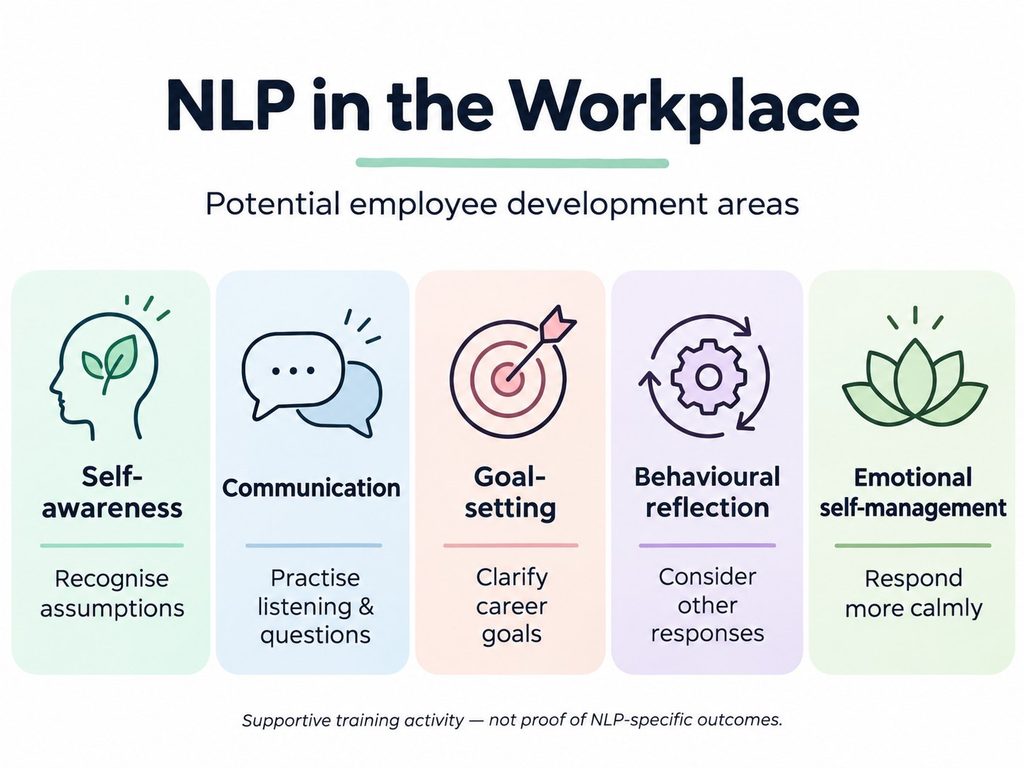
For example, an employee who avoids speaking during meetings may assume colleagues will reject their ideas.
An NLP-informed coaching exercise could encourage them to question this assumption, prepare one contribution and reflect on the outcome.
Gradually, they practise participating in situations they previously avoided.
Similar exercises can address difficulties with feedback, requesting assistance or handling disagreements.
Why Do These Skills Matter for Employee Retention?
Professional development requires more than technical knowledge.
Employees must also communicate ideas, navigate workplace relationships, receive feedback and adapt to changing responsibilities.
An employee struggling to express concerns may remain dissatisfied without management noticing. Similarly, someone with strong technical skills may avoid promotion because they lack leadership confidence.
Communication and self-reflection exercises offer opportunities to address these challenges.
However, employers should evaluate training through observable improvements rather than assume NLP techniques guarantee results.
The practical value of NLP training lies in whether employees apply the skills they practise to real workplace situations.
How Can NLP Align Employee Values With Company Vision?
Values exploration exercises used in NLP-informed coaching may help employees reflect on their professional motivations and how these relate to organisational objectives.
Career success means different things to different employees. Some prioritise leadership, while others value technical expertise, recognition, stability or autonomy.
Ignoring these differences can leave employees feeling overlooked, even when development programmes are available.
Understanding Individual Employee Motivations
Consider two employees in the same marketing department.
Employee A enjoys mentoring colleagues and hopes to become a department manager.
Employee B prefers analytical work and wants to specialise in technical SEO and data analysis.
Identical leadership training may suit Employee A but not Employee B. A personalised approach would offer management development for one and specialist training for the other.
Managers can explore these differences through questions such as:
- What motivates you most in your current role?
- Which skills would you like to develop?
- What would meaningful career progression look like?
- Which responsibilities would you like to explore?
- How can your goals support the company’s objectives?
These conversations help employers offer more relevant development opportunities.
Connecting Personal Ambitions With Business Goals
Once employees identify their priorities, managers can connect those ambitions with organisational objectives.
| Employee Priority | Company Objective | Development Opportunity |
| Leadership growth | Build future managers | Lead a small team project |
| Technical expertise | Improve operational efficiency | Attend specialist training |
| Professional recognition | Strengthen service quality | Lead an improvement initiative |
| Creative autonomy | Encourage innovation | Participate in new projects |
This helps employees understand how their development contributes to organisational performance.
When employees see how their aspirations connect with company goals, they have a clearer reason to invest in their future with the organisation.
However, alignment should be genuine, without pressuring employees to change their personal values.
How Can NLP Support an Executive Talent Retention Strategy?
NLP-informed coaching may complement an executive talent retention strategy by giving leaders opportunities to practise communication, feedback and goal-setting.
Research supports workplace coaching more broadly, but does not establish that NLP-specific methods improve retention.
Senior employees may become disengaged when their contributions feel overlooked, responsibilities become repetitive or career progression stalls.
Constructive conversations help managers recognise these concerns before employees consider leaving. This is one of many NLP benefits.
Improving Leadership Communication
One NLP communication technique, the Meta Model, encourages people to clarify vague statements and question assumptions.
For example, a manager might say:
“You need to demonstrate more leadership.”
Does this mean making independent decisions, mentoring colleagues or managing larger projects?
Without clarification, expectations remain unclear.
A more constructive conversation establishes:
- Which leadership behaviours need improvement?
- What responsibilities can the employee take on?
- What support or training is available?
- How will progress be evaluated?
This helps both parties agree on measurable goals.
Similarly, when an employee says, “Management never listens to our suggestions,” a manager can respectfully ask which situations created that impression.
Clear communication helps employees understand expectations while giving managers better insight into their teams’ needs.
Encouraging Coaching-Based Leadership
Traditional management often emphasises instructions and performance monitoring. Coaching also encourages employees to examine problems independently.
Instead of immediately offering solutions, managers might ask:
“What responsibilities would you like to take on, and what support would help you get there?”
An NLP program commonly incorporates questioning, rapport-building and reflection exercises for such conversations.
However, evidence supporting workplace coaching generally should not be treated as proof of NLP-specific effectiveness.
Developing Future Leaders
Executive retention also involves preparing employees for leadership.
A technically capable manager may hesitate to delegate because they believe every task requires personal supervision.
A coaching conversation could help them question this assumption and identify a manageable delegation opportunity.
For example, they could assign a project to a junior colleague, establish milestones and review performance afterwards.
Results can be assessed through project delivery, employee independence and management workload.
The objective is to develop leaders who communicate clearly, recognise employee aspirations and create genuine progression opportunities.
Can NLP Break the Corporate Burnout Cycle Through Internal State Management?
NLP programmes may include exercises encouraging employees to recognise emotional responses and consider how to handle workplace pressure.
However, the effectiveness of NLP-specific state management techniques remains scientifically uncertain.
Within NLP, an internal state refers to someone’s emotional and mental condition at a particular moment.
Employees may feel confident during familiar tasks but anxious when facing criticism, difficult customers or urgent deadlines.
Recognising these reactions may help them respond more deliberately.
Common Internal State Management Techniques
NLP programmes may introduce exercises such as:
- Reframing: Considering alternative interpretations of difficult situations.
- Visualisation: Mentally preparing for challenging conversations or responsibilities.
- Anchoring: Associating a cue with a desired emotional state.
- Self-reflection: Recognising thoughts and behaviours contributing to stress.
For example, an employee receiving criticism might think:
“My manager believes I am incompetent.”
Through reframing, they could instead ask:
“Which part of my work needs improvement, and what can I do differently?”
This redirects attention towards specific actions.
Such exercises offer opportunities for reflection, but their effectiveness should not be assumed. In particular, NLP-specific mechanisms such as anchoring lack strong scientific validation.
Why Burnout Requires More Than Mindset Training
The World Health Organization describes burnout as an occupational phenomenon linked to chronic workplace stress that has not been successfully managed.
It involves exhaustion, increased mental distance from work and reduced professional effectiveness.
Consider a customer service employee handling excessive complaints daily.
Communication training might help them respond more calmly, but understaffing and unrealistic targets would remain unresolved.
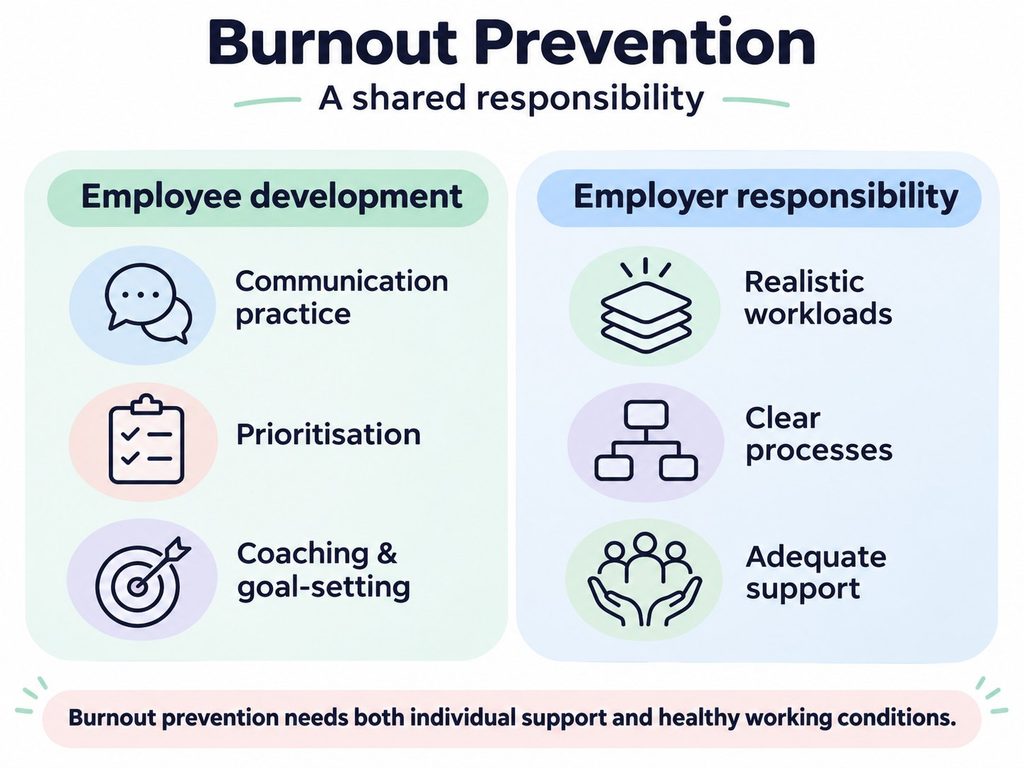
Employers must distinguish between individual development needs and organisational responsibilities.
| Workplace Challenge | Employee Development | Employer Responsibility |
| Difficult conversations | Communication practice | Clear escalation procedures |
| Repeated deadline pressure | Prioritisation skills | Realistic workload planning |
| Workplace disagreements | Active listening | Fair conflict resolution |
| Performance anxiety | Coaching and goal-setting | Constructive supervision |
| Persistent exhaustion | Wellbeing support | Review staffing and workloads |
NLP benefits may complement workplace wellbeing initiatives, but burnout prevention requires employers to address excessive workplace stress.
NLP is not mental health treatment. Employees experiencing persistent psychological difficulties should have access to qualified mental health professionals.
How Does NLP for Personal Growth Support Employee Development?
NLP programmes often encourage reflection, goal-setting and exploration of behavioural habits. These activities may support development, although improvements should not automatically be attributed to NLP.
Employees sometimes limit opportunities because of assumptions about their abilities.
For example, a junior executive may believe they lack leadership confidence despite having organised meetings, guided colleagues or managed smaller assignments.
Recognising these experiences can help them identify skills to develop and responsibilities to pursue.
Turning Personal Goals Into Workplace Actions
Personal development becomes more useful when ambitions translate into observable behaviours.
Instead of aiming to “become a better communicator”, an employee might:
- Contribute one suggestion during weekly meetings.
- Deliver a short presentation within a month.
- Request feedback after completing an assignment.
- Identify one communication habit to improve.
- Review progress with their manager after six weeks.
These actions provide opportunities to practise skills and measure improvement.
Regular development conversations also help employers identify employees interested in additional responsibilities, internal mobility or different career paths.
Meaningful progress becomes easier to recognise when goals are specific, achievable and supported by management.
How Should Malaysian Employers Introduce NLP Training?
Malaysian employers considering NLP training should start by identifying workplace challenges rather than introducing programmes simply to fulfil annual training targets.
1. Identify the Development Gap
Review employee feedback, exit interviews and performance discussions.
Determine whether concerns involve communication, leadership confidence, career planning or structural issues.
If employees are leaving because of inadequate compensation, NLP training should not be the primary response.
2. Start With a Targeted Programme
A small pilot involving managers or future leaders can provide useful feedback.
For example, a 90-day programme could focus on coaching conversations, clearer questioning, development goals and follow-up actions.
3. Measure Workplace Application
Rather than relying on attendance, employers should evaluate whether participants apply their learning.
Possible indicators include:
- Quality of development conversations
- Completion of agreed development actions
- Employee feedback on communication
- Improvements in leadership behaviours
- Participation in development opportunities
These measures help assess training relevance, although improvements should not automatically be attributed to NLP when other initiatives occur simultaneously.
4. Reinforce Learning Beyond the Workshop
One training session is unlikely to change established habits.
Managers should provide opportunities to practise skills, receive feedback and review progress.
The most suitable programme integrates learning into everyday responsibilities and supports a wider development strategy.
Utilizing NLP Training Well
NLP-informed training may offer opportunities for communication practice, self-awareness, goal-setting and coaching, although strong evidence for NLP-specific benefits remains limited.
For Malaysian employers, these activities can complement talent development and retention strategies when supported by career opportunities, manageable workloads and healthy working conditions.
At The Box Training, we offer NLP training programmes focused on practical communication, coaching and personal development skills. Our programmes can be considered as part of a broader strategy to develop employees and strengthen workplace leadership.
Frequently Asked Questions About NLP Benefits
What Are the Main Benefits of NLP?
NLP training commonly focuses on communication, self-awareness, goal-setting and personal development. These activities may help individuals practise workplace skills, although evidence for NLP-specific effectiveness remains limited.
Can NLP Improve Employee Retention?
NLP-informed training may complement employee development and coaching. However, there is insufficient evidence that NLP directly reduces turnover. Retention also depends on compensation, career progression and working conditions.
Is NLP Suitable for Managers and Business Leaders?
Managers may use NLP-informed questioning and reflection exercises to practise communication, feedback and coaching. Effectiveness should be assessed through observable workplace behaviours.
Can NLP Help Employees Manage Workplace Stress?
NLP programmes may encourage reflection on emotional responses and constructive communication. However, NLP is not an established mental health treatment or a substitute for organisational burnout prevention.
How Is NLP Different From Traditional Employee Training?
Traditional training often focuses on technical and job-specific skills. NLP programmes emphasise communication, thinking patterns and behavioural reflection, although some activities overlap with established coaching methods.
How Can Employers Evaluate NLP Training?
Employers can monitor communication practices, development-plan completion, employee feedback and behavioural changes. Clear objectives help determine whether participants apply what they learn.
Make the NLP claims more consistentStrengthen the training service call to action