
Key Takeaways
- Time Line Therapy® training may interest coaches, business leaders, HR professionals and personal development learners.
- Coaches can explore additional techniques for goal-setting, personal reflection and examining limiting beliefs.
- HR teams should assess workplace relevance, employee consent and learning outcomes before arranging training.
- Time Line Therapy® certification does not qualify someone to provide regulated mental health treatment.
- Compare trainer credentials, certification requirements and practical learning opportunities before enrolling.
Time Line Therapy® training in Malaysia may interest professional coaches, business leaders, HR practitioners, corporate trainers and individuals interested in personal development. It introduces structured techniques for exploring past experiences, personal beliefs and future goals.
However, its effectiveness for specific professional or psychological outcomes has not been firmly established by high-quality independent research.
Not everyone needs certification. Whether you should learn Time Line Therapy® depends on your professional responsibilities, learning objectives and intended applications.
This guide explains who may benefit from Time Line Therapy® training, who should reconsider and what to check before enrolling.
Who Is Time Line Therapy® Training Suitable For?
Time Line Therapy® attracts people from different backgrounds, particularly those interested in coaching, self-awareness and personal development.
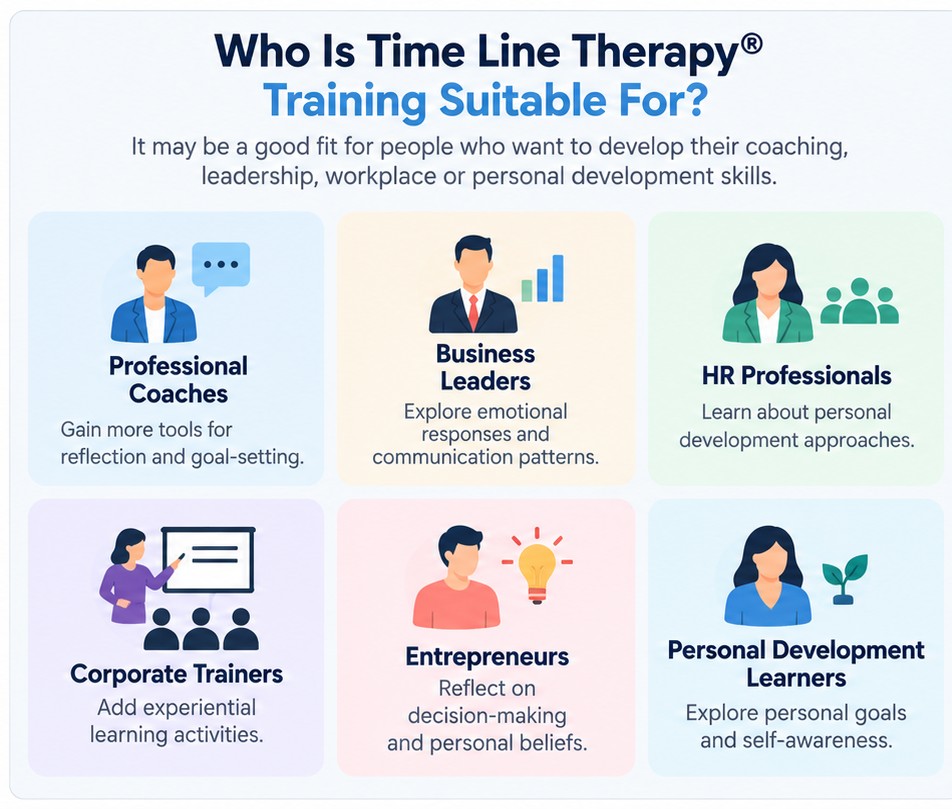
The best candidates are those who understand what they want to achieve and how they will apply their learning.
Why Should Professional Coaches Learn Time Line Therapy®?
Professional coaches may consider Time Line Therapy® to broaden their understanding of reflective techniques, personal beliefs and goal-setting.
The methodology is associated with Neuro-Linguistic Programming (NLP) and is often taught alongside NLP Practitioner and coaching certification programmes.
Exploring Limiting Beliefs
Coaching clients sometimes express beliefs such as:
- “I’m not confident enough to lead.”
- “I always make the wrong decisions.”
- “My previous failures will happen again.”
Time Line Therapy® introduces structured exercises for exploring how individuals interpret past experiences and how those interpretations relate to present expectations.
For coaches, these techniques may offer an additional framework for facilitating reflection.
However, coaches should avoid assuming that every current difficulty originates from a particular past experience.
Supporting Personal and Professional Goals
Some Time Line Therapy® exercises involve imagining future outcomes and considering personal development goals.
For example, a career coach working with someone hesitant about applying for a promotion might help them:
- Identify their career aspirations.
- Examine concerns influencing their decisions.
- Consider alternative perspectives.
- Develop practical steps towards their goals.
The objective should be to support constructive reflection and realistic action.
Important: Time Line Therapy® certification does not qualify a coach to diagnose or treat psychological conditions.
Can Business Leaders Benefit From Time Line Therapy®?
Business leaders may find Time Line Therapy® relevant when exploring their reactions to workplace challenges, communication habits and decision-making patterns.
Leadership often involves handling disagreements, receiving criticism and making difficult decisions.
Understanding Emotional Responses
Consider a manager who becomes defensive whenever employees question their decisions.
Through structured reflection, they might examine:
- What triggers their defensive reactions.
- Whether their assumptions are accurate.
- How their behaviour affects colleagues.
- How they could respond more constructively.
This type of reflection can complement leadership development.
However, completing a Time Line Therapy® course does not guarantee improvements in leadership performance.
Managers still need practical skills in communication, conflict resolution, delegation and performance management.
Improving Workplace Conversations
Leaders interested in personal development may explore the methodology alongside conventional leadership training.
For example, a newly promoted supervisor might combine reflective learning with workshops on giving feedback and managing difficult conversations.
The value comes from applying appropriate skills consistently, rather than relying on one technique to resolve every workplace challenge.
Should HR Professionals Consider Time Line Therapy® Training?
HR and Learning & Development (L&D) professionals may explore Time Line Therapy® when reviewing employee development programmes or coaching approaches.
However, organisations should first identify the capabilities they want employees to develop.
Matching Training to Workplace Needs
| Workplace Challenge | Training to Consider |
| Poor communication | Communication skills training |
| Team disagreements | Conflict management workshops |
| New leadership responsibilities | Leadership coaching and mentoring |
| Interest in personal reflection | Voluntary personal development training |
| Significant psychological distress | Qualified mental health support |
Time Line Therapy® may be considered for personal development activities, provided participation is appropriate and voluntary.
Employees should never feel pressured to disclose sensitive memories or personal experiences during workplace training.
Is Time Line Therapy® Training HRD Corp Claimable?
Some Time Line Therapy® programmes may qualify under HRD Corp’s Claimable Courses scheme, depending on the specific programme and employer.
Malaysian employers should check:
- Whether the training provider is registered with HRD Corp.
- Whether the specific course is registered under the applicable scheme.
- Whether their organisation meets the eligibility requirements.
- Whether the employer’s grant application has been approved before training begins.
HRD Corp also sets advance-approval requirements. As of October 2026, in-house training can generally begin 14 days after grant approval, while public training can begin after three days until 31 December 2026. From 1 January 2027, the 14-day requirement will also apply to public training.
Employers should verify the latest conditions and training schedules directly with HRD Corp.
A provider being HRD Corp registered does not automatically make every programme claimable.
Is Time Line Therapy® Useful for Corporate Trainers?
Corporate trainers may be interested in learning Time Line Therapy® because some programmes introduce visualisation, guided reflection and other experiential exercises.
These methods may provide ideas for personal development workshops.
For example, a trainer could facilitate a voluntary activity asking participants to reflect on their career goals and identify obstacles.
However, trainers must distinguish ordinary workplace reflection from exercises involving emotionally sensitive memories.
Before introducing such activities, consider:
- Whether participation is voluntary.
- Whether the exercise supports the learning objectives.
- How participant confidentiality will be protected.
- Whether the trainer can respond appropriately if someone becomes distressed.
Corporate training should focus on professional development, not unqualified psychological treatment.
Should Entrepreneurs Learn Time Line Therapy®?
Entrepreneurs may consider Time Line Therapy® for personal reflection, particularly when examining their responses to setbacks, criticism or uncertainty.
For example, a business owner who repeatedly postpones launching a service might believe they lack confidence.
However, their hesitation could reflect several practical concerns:
- Insufficient market research.
- Financial uncertainty.
- Unclear pricing.
- Previous unsuccessful launches.
- Fear of negative customer feedback.
Reflection may help the entrepreneur understand these concerns, but it cannot replace practical business planning.
If the underlying issue is financial risk, preparing a cash-flow forecast may be more useful than attending a personal development programme.
Time Line Therapy® may complement an entrepreneur’s learning, but its relevance depends on the problem they want to address.
Can Beginners Learn Time Line Therapy® for Personal Development?
Yes. Individuals without professional coaching experience may explore Time Line Therapy® for personal development, subject to the course’s entry requirements.
Some programmes introduce concepts related to memories, beliefs, emotional experiences and future goals.
People may be interested in learning the methodology to:
- Develop greater self-awareness.
- Examine recurring personal assumptions.
- Reflect on previous experiences.
- Clarify personal and professional goals.
- Explore different approaches to personal development.
However, beginners do not necessarily need practitioner certification.
If your main goal is personal learning, an introductory workshop may be sufficient.
A full certification programme may be more relevant if you intend to develop professional coaching skills or pursue further training.
Who Should Reconsider Time Line Therapy® Training?
Time Line Therapy® may not suit individuals seeking treatment for mental health conditions or expecting guaranteed emotional transformation.
Although its name includes “therapy”, the methodology should not be confused with regulated psychological or counselling services.
People Seeking Mental Health Treatment
Individuals experiencing severe anxiety, depression, trauma-related symptoms or significant emotional distress should seek guidance from appropriately qualified mental health professionals.
Independent evidence supporting NLP-based approaches for clinical health outcomes remains limited.
A 2012 systematic review published in the British Journal of General Practice found little evidence that NLP improves health-related outcomes. A 2024 academic commentary also highlighted concerns about NLP’s scientific evidence.
These publications examine NLP broadly rather than directly establishing the clinical effectiveness of Time Line Therapy®.
Time Line Therapy® should not replace professional mental healthcare.
People Expecting Guaranteed Results
Be cautious about programmes promising:
- Permanent removal of negative emotions.
- Guaranteed recovery from traumatic experiences.
- Immediate personality transformation.
- Reliable treatment of psychological disorders.
Such claims require credible clinical evidence.
A responsible provider should explain the methodology’s limitations and appropriate applications.
Employers Seeking a Quick Workplace Fix
Training alone cannot resolve organisational problems such as excessive workloads, unclear responsibilities or poor management practices.
These issues require practical workplace improvements rather than expecting employees to change their emotional responses.
What Will You Learn in a Time Line Therapy® Course?
Time Line Therapy® training commonly introduces a framework based on how individuals subjectively organise memories and imagine future experiences.
Depending on the programme, participants may explore:
- Timeline Concepts: Understanding how the methodology represents past and future experiences.
- Personal Beliefs: Examining interpretations and assumptions associated with previous experiences.
- Guided Reflection: Practising structured exercises involving memories and visualisation.
- Goal-Setting: Exploring desired outcomes and future-oriented thinking.
- Professional Boundaries: Understanding consent, confidentiality and appropriate applications.
Some Malaysian providers combine Time Line Therapy® with NLP Practitioner and NLP coaching programmes.
As course content varies, always request the syllabus before enrolling.
How Do You Choose Time Line Therapy® Training in Malaysia?
Choosing a suitable Time Line Therapy® course requires comparing certification, trainer credentials, practical exercises and programme requirements.
Check the Certification
Some programmes offer certification associated with the Time Line Therapy™ Association, which has its own certification and membership requirements.
Before registering, ask:
- Which organisation issues or recognises the certificate?
- Does the programme include practical assessments?
- Are there prerequisites?
- Are membership or annual renewal fees required?
- Can the trainer’s credentials be verified?
Private certification and association membership should not be confused with government-issued professional qualifications.
In Malaysia, a Time Line Therapy® certificate does not qualify someone as a registered counsellor. Counselling practice is regulated under the Counsellors Act 1998 (Act 580), with registration overseen by Lembaga Kaunselor Malaysia.
Compare Training Providers
| Factor | What to Check |
| Course Content | Topics covered and learning objectives |
| Trainer Credentials | Qualifications and relevant experience |
| Learning Format | Classroom, online or blended |
| Practical Sessions | Opportunities for supervised practice |
| Certification | Issuing body and assessment requirements |
| Course Fees | Inclusions and additional charges |
| HRD Corp Eligibility | Whether the specific programme qualifies |
Avoid choosing a course solely because it promises rapid personal transformation.
Look for transparent learning outcomes, appropriate safeguards and realistic explanations of what participants can expect.
Is Time Line Therapy® Training Worth It for Malaysian Employers?
Time Line Therapy® training may be worth considering when it supports a defined employee development objective. However, employers should compare it with other training approaches before committing.
Consider a Malaysian company with eight department managers.
The HR team wants to improve how managers handle difficult workplace conversations.
After reviewing employee feedback, it identifies three problems:
- Managers avoid giving constructive feedback.
- Team disagreements are handled poorly.
- Performance expectations are unclear.
The company compares several programmes.
| Training Option | Potential Suitability |
| Leadership and Feedback Training | Directly addresses the identified problems |
| Professional Coaching Skills | Supports structured developmental conversations |
| Time Line Therapy® | May complement voluntary personal reflection |
For this situation, leadership and feedback training offers the clearest match.
Time Line Therapy® could be considered as supplementary learning if the organisation identifies a relevant need.
After training, HR should evaluate actual workplace behaviour, such as the quality of feedback conversations and employee understanding of performance expectations.
The important question is whether the training develops the capabilities employees genuinely need.
How Do You Know Whether Time Line Therapy® Is Right for You?
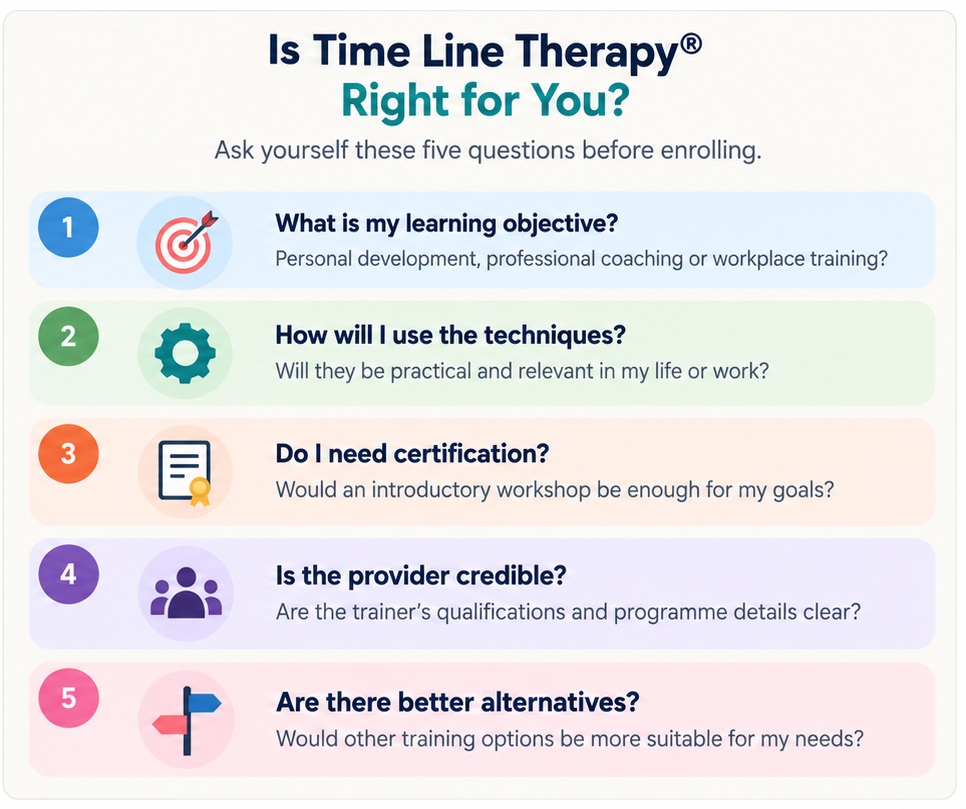
Before enrolling, answer these five questions:
- What is my learning objective? Personal development, professional coaching or workplace training?
- How will I use the techniques? Will they have an appropriate application in my personal or professional life?
- Do I need certification? Would an introductory workshop meet my needs?
- Is the provider credible? Are the trainer’s qualifications, assessment requirements and programme limitations explained?
- Are there better alternatives? Would coaching education, leadership training, mentoring or another programme be more relevant?
If you can answer these questions clearly, you are better positioned to make an informed training decision.
Should You Learn Time Line Therapy® in Malaysia?
Time Line Therapy® training may interest coaches, business leaders, HR professionals, trainers and individuals exploring personal development. However, its value depends on your learning goals, professional responsibilities and how you intend to apply the techniques.
If you’re interested in exploring NLP, coaching and Time Line Therapy® techniques, The Box Training offers NLP training in Malaysia, including a combined certification programme incorporating Time Line Therapy®. Review the course syllabus, certificate issuer and learning format to see whether it matches your professional goals and learning needs.
Sources and References
- Time Line Therapy™ Association. Official certification and membership information.
- Sturt, J., et al. (2012). Neurolinguistic Programming: A Systematic Review of the Effects on Health Outcomes. British Journal of General Practice.
- Neurolinguistic Programming: Old Wine in New Glass. (2024). Academic commentary on NLP’s scientific evidence.
- Human Resource Development Corporation (HRD Corp). HRD Corp Claimable Courses and programme registration guidance.
- Lembaga Kaunselor Malaysia. Counsellors Act 1998 (Act 580) and professional registration guidance.
- The Box Training Malaysia. NLP Practitioner and Time Line Therapy® programme information.
Frequently Asked Questions
Do I Need NLP Certification Before Learning Time Line Therapy®?
Not always. Requirements vary by provider. Some Malaysian programmes combine NLP Practitioner and Time Line Therapy® certification, while others specify prerequisites.
How Long Does Time Line Therapy® Training Take in Malaysia?
Course duration depends on the provider and whether Time Line Therapy® is offered independently or as part of a combined NLP certification programme.
Can I Learn Time Line Therapy® Online?
Some providers offer online or blended training. Confirm whether the format meets the relevant certification requirements and includes practical assessment.
Is Time Line Therapy® Certification Recognised in Malaysia?
Time Line Therapy® certification is a private training credential rather than a Malaysian government-issued counselling qualification.
Recognition depends on the issuing organisation and the requirements of the employer or professional body considering the certificate.
To practise as a registered counsellor in Malaysia, individuals must meet the relevant requirements under the Counsellors Act 1998 (Act 580).
Can Malaysian Companies Arrange Time Line Therapy® Training for Employees?
Yes. Companies can enquire about group training, but should evaluate workplace relevance, employee consent, programme safeguards and HRD Corp eligibility beforehand.
Is Time Line Therapy® Suitable for Someone Without Coaching Experience?
Yes, depending on the course requirements. Beginners interested in personal development may start with introductory training before deciding whether practitioner certification is necessary.