
Key Takeaways
- Time Line Therapy® is an NLP-related technique that explores past experiences, emotional patterns and limiting beliefs.
- It uses guided reflection and visualisation to help participants reconsider unhelpful responses, although its effectiveness remains scientifically unproven.
- Common applications include personal development, confidence-building and emotional awareness.
- Malaysian companies may encounter it within NLP, coaching and leadership training programmes.
- Scientific evidence remains limited, so it should not replace evidence-based psychological care.
Time Line Therapy® is a personal development technique that uses guided visualisation and reflection to explore how past experiences, emotions and beliefs may influence present behaviour. It is commonly taught alongside Neuro-Linguistic Programming (NLP).
For Malaysian businesses exploring employee development, Time Line Therapy may offer a reflective component within broader communication and leadership training.
This guide explains how it works, its common applications and what companies should consider before choosing Time Line Therapy training.
What Is Time Line Therapy?
Time Line Therapy® is an NLP-related approach developed and popularised by Tad James. It is based on the idea that people can imagine past and future experiences along a personal timeline. This is a framework used in the technique, rather than a scientifically established explanation of how memories are stored.
For example, someone might imagine their childhood behind them, recent experiences nearby and future goals ahead.
Practitioners use this imagined timeline to guide participants through exercises focused on three areas:
- Emotional patterns: Recurring feelings such as fear, frustration or defensiveness.
- Limiting decisions: Beliefs that may restrict confidence or behaviour.
- Future goals: Visualising more constructive responses and desired outcomes.
The intention is to help participants reconsider how they interpret previous experiences.
For example, an employee who received harsh criticism early in their career might continue associating feedback with failure. This could influence how they respond to performance reviews years later.
Time Line Therapy exercises encourage participants to examine these associations and consider alternative interpretations.
However, Time Line Therapy is not a clinically established psychological treatment, and claims that it permanently eliminates negative emotions have not been reliably demonstrated.
How Does Time Line Therapy Work?
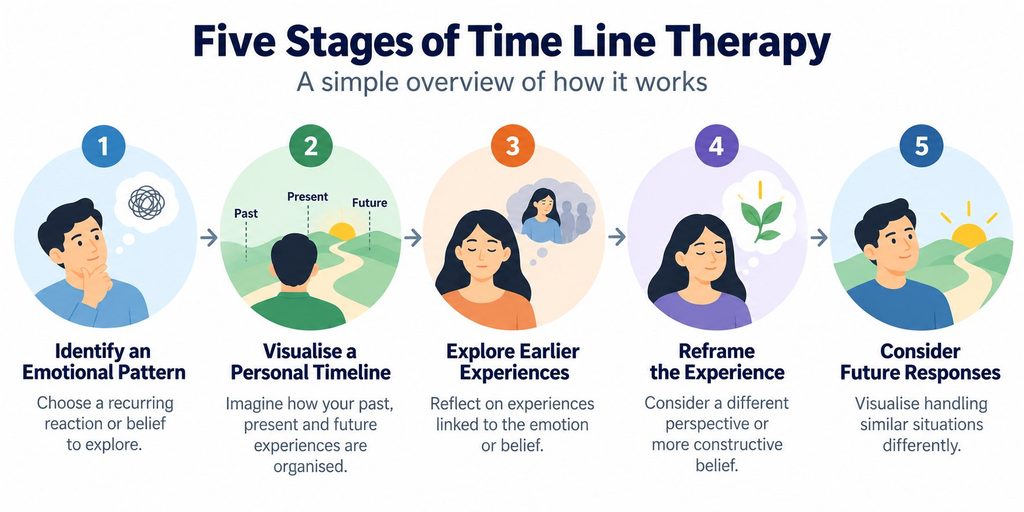
Time Line Therapy uses guided exercises to explore past experiences, emotional reactions and future responses. The five stages below offer a simplified explanation of the process, rather than a fixed protocol followed by every practitioner.
1. Identify an Emotional Pattern
The participant identifies a recurring reaction or belief they want to explore.
For example, a manager may become defensive whenever employees question their decisions.
The practitioner may ask when this reaction occurs and how it affects the participant’s relationships or performance.
2. Visualise a Personal Timeline
The practitioner guides the participant to imagine how their past, present and future experiences are organised.
Some people imagine a straight line extending from behind them towards the future. Others picture events from left to right.
There is no single correct visualisation. The timeline serves as a mental framework for reflection.
3. Explore Earlier Experiences
The participant reflects on experiences they associate with the emotion or belief.
For example, someone afraid of public speaking might recall receiving criticism during a school presentation.
The objective is to explore the interpretation attached to that experience, not to establish whether every remembered detail is accurate.
4. Reframe the Experience
The practitioner encourages the participant to consider a different perspective.
Instead of thinking, “I’m terrible at presentations,” the person might adopt a more constructive belief:
“I can improve my presentation skills through preparation and practice.”
This exercise is intended to encourage more flexible thinking rather than erase the original experience.
5. Consider Future Responses
Finally, the participant visualises handling a similar situation differently.
For example, they might imagine delivering a presentation confidently or responding calmly to constructive criticism.
For workplace development, this should be followed by practical exercises, feedback and opportunities to apply the desired behaviour.
What Are Emotional Patterns and Limiting Decisions?
Emotional patterns are recurring reactions to situations, while limiting decisions are beliefs that may discourage someone from pursuing opportunities or changing their behaviour.
Both concepts are frequently explored during Time Line Therapy training.
| Limiting Decision | Possible Workplace Impact | Constructive Alternative |
| “I’m not leadership material.” | Avoiding management responsibilities | Leadership skills can be developed |
| “Making mistakes means failure.” | Perfectionism and delayed decisions | Mistakes provide learning opportunities |
| “Nobody listens to my ideas.” | Staying silent during meetings | Communication skills can improve |
| “I cannot handle conflict.” | Avoiding difficult conversations | Conflict management can be learnt |
Consider an employee who avoids giving presentations after an embarrassing experience.
Although their communication skills may have improved, they might continue believing they are incapable of speaking confidently.
Time Line Therapy exercises aim to help participants examine such interpretations.
How Can Limiting Decisions Affect Workplace Behaviour?
Limiting decisions can influence how employees approach responsibilities, relationships and professional development.
For instance, an experienced employee who believes they are poor at leadership may repeatedly decline supervisory opportunities despite possessing the necessary technical skills.
Likewise, a manager who associates disagreement with disrespect may struggle to encourage open discussions.
Recognising these beliefs can provide a starting point for personal development.
However, not every workplace challenge results from limiting beliefs. Inadequate training, unclear expectations and organisational problems can also affect employee performance.
What Is Time Line Therapy Commonly Used For?
Time Line Therapy is commonly promoted for personal development, emotional awareness and exploring self-limiting beliefs.
In corporate training, its techniques may be introduced in several areas.
Confidence and Self-Belief
Employees may hesitate to speak during meetings, accept responsibilities or pursue promotions because they doubt their abilities.
Reflective exercises are intended to encourage participants to examine those assumptions.
However, confidence-building should also involve practical skills development and constructive feedback.
Emotional Awareness
Employees and managers sometimes react defensively during disagreements or performance reviews.
Time Line Therapy exercises encourage reflection on what triggers these reactions and how participants might respond more constructively.
For example, a supervisor who becomes frustrated when receiving questions might learn to distinguish genuine challenges to their authority from employees seeking clarification.
Leadership Development
Managers often need to navigate criticism, uncertainty and difficult conversations.
Reflecting on personal beliefs may help leaders recognise habits that influence their management approach.
For example, a manager who believes asking for help demonstrates weakness might reconsider that assumption.
Adapting to Workplace Change
Employees may resist organisational changes because of previous negative experiences.
Guided reflection may encourage them to reassess their expectations.
However, successful change management still requires clear communication, adequate training and organisational support.
These are potential applications, not scientifically established outcomes of Time Line Therapy.
Read More: How to Use Behavioural Modeling to Improve Team Performance
Can Time Line Therapy Improve Employee Performance?
Time Line Therapy may support self-reflection within corporate training, but there is insufficient high-quality evidence proving that the technique independently improves employee productivity or workplace performance.
Its usefulness should therefore be evaluated against specific learning objectives.
For example, imagine a Malaysian company introducing a leadership programme for 20 managers.
The programme includes:
- Reflection on emotional reactions to feedback.
- Communication skills training.
- Role-playing difficult conversations.
- Follow-up assessments.
Suppose the managers’ average communication assessment score improves from 2.8 to 3.6 out of 5.
The percentage improvement would be:
(3.6 − 2.8) ÷ 2.8 × 100 = 28.6%
This is a hypothetical example, not a documented Time Line Therapy result.
Although the improvement would be encouraging, it would not establish which training component caused the change.
HR teams should measure observable workplace behaviours rather than assume that completing a programme automatically improves performance.
Companies can also collect feedback from participants and supervisors several weeks after training to assess whether employees are applying what they learnt.
Is Time Line Therapy Scientifically Proven?
Scientific evidence supporting Time Line Therapy remains limited.
A 2012 systematic review published in the British Journal of General Practice found little evidence that NLP interventions improve health-related outcomes. The researchers noted that the available studies were limited in quantity and quality.
Importantly, the review examined NLP more broadly, not Time Line Therapy specifically. Its findings highlight gaps in the wider evidence base but cannot independently establish whether Time Line Therapy is effective or ineffective.
The World Health Organization’s 2022 workplace mental health guidelines recommend considering interventions such as organisational changes, manager training and appropriate individual support.
The strength of the evidence varies by intervention and outcome. These approaches have been formally evaluated in workplace mental health research, unlike Time Line Therapy, which has limited direct supporting evidence.
Time Line Therapy should not replace professional psychological treatment for depression, anxiety disorders, trauma-related conditions or other mental health concerns.
For employers, participation in emotionally focused exercises should be voluntary, with appropriate privacy safeguards.
Is Time Line Therapy Suitable for Corporate Training in Malaysia?
Time Line Therapy may be considered as an optional reflective component within a broader corporate training programme.
Its suitability depends on the organisation’s objectives and employees’ needs.
| Business Objective | Potential Role of Time Line Therapy | Other Training to Consider |
| Leadership development | Reflecting on personal beliefs | Leadership coaching |
| Communication skills | Exploring emotional reactions | Communication workshops |
| Employee confidence | Examining limiting assumptions | Presentation and skills training |
| Managing workplace change | Reflecting on attitudes | Change management training |
| Mental health support | Not a clinical treatment | Qualified psychological support |
For example, employees struggling with presentations may benefit more directly from structured presentation training.
Meanwhile, organisations experiencing burnout due to excessive workloads should address those working conditions rather than relying exclusively on mindset-related workshops.
When Might It Be Worth Considering?
Time Line Therapy may be worth exploring when employees voluntarily want to develop greater self-awareness or examine beliefs affecting their professional confidence.
It can also be introduced alongside established coaching and communication exercises.
However, companies should establish realistic expectations. A reflective workshop alone cannot guarantee improved employee performance or resolve organisational problems.
The most suitable training programme is one that addresses the actual performance problem.
What Should Companies Look for in Time Line Therapy Training?
Before enrolling employees in Time Line Therapy Malaysia programmes, employers should evaluate several factors.
Trainer Qualifications
Check the trainer’s certification, relevant experience and ability to deliver practical workplace learning.
A Time Line Therapy practitioner certification is a training credential, not a clinical psychology qualification or proof of treatment effectiveness. For mental health concerns, employers should seek appropriately qualified healthcare professionals.
Training Content
Ask whether the programme includes NLP concepts, practical exercises, coaching techniques and workplace applications.
Some programmes combine several certifications, while others focus specifically on Time Line Therapy.
Employee Privacy
Participation in emotionally focused exercises should be voluntary. Employees should not be pressured to disclose traumatic experiences or sensitive personal information.
Employers and training providers should use appropriate privacy safeguards and follow applicable requirements under Malaysia’s Personal Data Protection Act 2010, as amended.
Trainers should also establish clear boundaries and refer participants to qualified mental health professionals when clinical concerns arise.
Practical Learning Outcomes
Identify measurable goals, such as improved communication, more constructive feedback discussions or stronger leadership skills.
For Malaysian employers, it is also worth confirming programme duration, assessment requirements and any applicable HRD Corp claim eligibility before registration.
How Is Time Line Therapy Different From NLP Training?
Time Line Therapy focuses specifically on subjective timelines, emotional patterns and limiting decisions, while NLP training covers a broader range of communication and behavioural concepts.
| Time Line Therapy | NLP Training |
| Focuses on past experiences and emotional interpretations | Covers communication, language and behavioural patterns |
| Uses guided timeline visualisation | Uses questioning, reframing and communication exercises |
| Often taught as a specialised technique | Available through broader practitioner programmes |
Some Malaysian training providers integrate Time Line Therapy into NLP practitioner and coaching certification programmes.
This allows participants to learn several approaches within one training structure.
However, course certification does not automatically demonstrate clinical competence or guarantee workplace performance improvements.
What Happens During Time Line Therapy Training?
Depending on the provider, participants may attend trainer demonstrations, guided reflection sessions and paired exercises.
A structured programme may also include discussions about NLP principles, communication techniques and professional coaching applications.
Participants should expect opportunities to practise the techniques and receive feedback.
Before enrolling, ask whether the programme is designed for personal development, professional practitioner certification or workplace skills training. These formats can have different learning objectives and assessment requirements.
Conclusion
Time Line Therapy uses guided reflection to explore emotional patterns, limiting beliefs and future responses. For Malaysian companies, it may complement broader personal development and leadership training, provided its limitations are understood.
For organisations considering structured employee development, The Box Training offers NLP training programmes incorporating NLP, coaching and Time Line Therapy. Reviewing your team’s communication challenges and learning objectives can help determine whether the programme suits your organisation.
Sources / References
- Time Line Therapy Association. What Is Time Line Therapy?
- Sturt, J. et al. (2012). Neurolinguistic Programming: A Systematic Review of the Effects on Health Outcomes. British Journal of General Practice.
- World Health Organization (2022). WHO Guidelines on Mental Health at Work.
- Malaysia Personal Data Protection Act 2010, as amended.
- HRD Corp. HRD Corp Claimable Courses.
- The Box Training. Time Line Therapy Practitioner Training and NLP Practitioner Triple Certification Programme.
Frequently Asked Questions About Time Line Therapy
Is Time Line Therapy a Form of Hypnosis?
Time Line Therapy uses guided visualisation and reflection. Although sometimes taught alongside hypnosis-related techniques, the two approaches are not identical.
Can Time Line Therapy Remove Negative Emotions Permanently?
There is insufficient reliable clinical evidence demonstrating that Time Line Therapy permanently eliminates negative emotions.
Do You Need NLP Experience Before Learning Time Line Therapy?
Not necessarily. Some Malaysian providers include Time Line Therapy within beginner-friendly NLP practitioner programmes, although advanced courses may have prerequisites.
How Long Does Time Line Therapy Training Take?
Duration varies according to the provider, certification requirements and whether NLP or coaching modules are included.
Is Time Line Therapy Training HRD Corp Claimable?
Some Time Line Therapy courses may qualify for HRD Corp funding when offered through eligible, registered training programmes. Employers should verify programme registration, their own eligibility and grant requirements before enrolling. Claimability does not guarantee funding approval.
Who Should Attend Time Line Therapy Training?
Time Line Therapy training may suit managers, team leaders, HR professionals, coaches and employees interested in personal development. It is particularly relevant to those exploring self-awareness, emotional responses and limiting beliefs as part of broader workplace development.